Ever opened your prescription bottle and seen a different name than what your doctor wrote? You’re not alone. Most people assume the cheaper version is somehow weaker, less safe, or just a knockoff. But here’s the truth: generic drugs are not cheaper because they’re worse. They’re cheaper because they don’t carry the same weight of debt.
Let’s say you’re on Lipitor for cholesterol. The brand-name version costs around $500 a month. The generic, atorvastatin? Four dollars. That’s not a typo. That’s not a scam. That’s how the system actually works.
Why Brand-Name Drugs Cost So Much
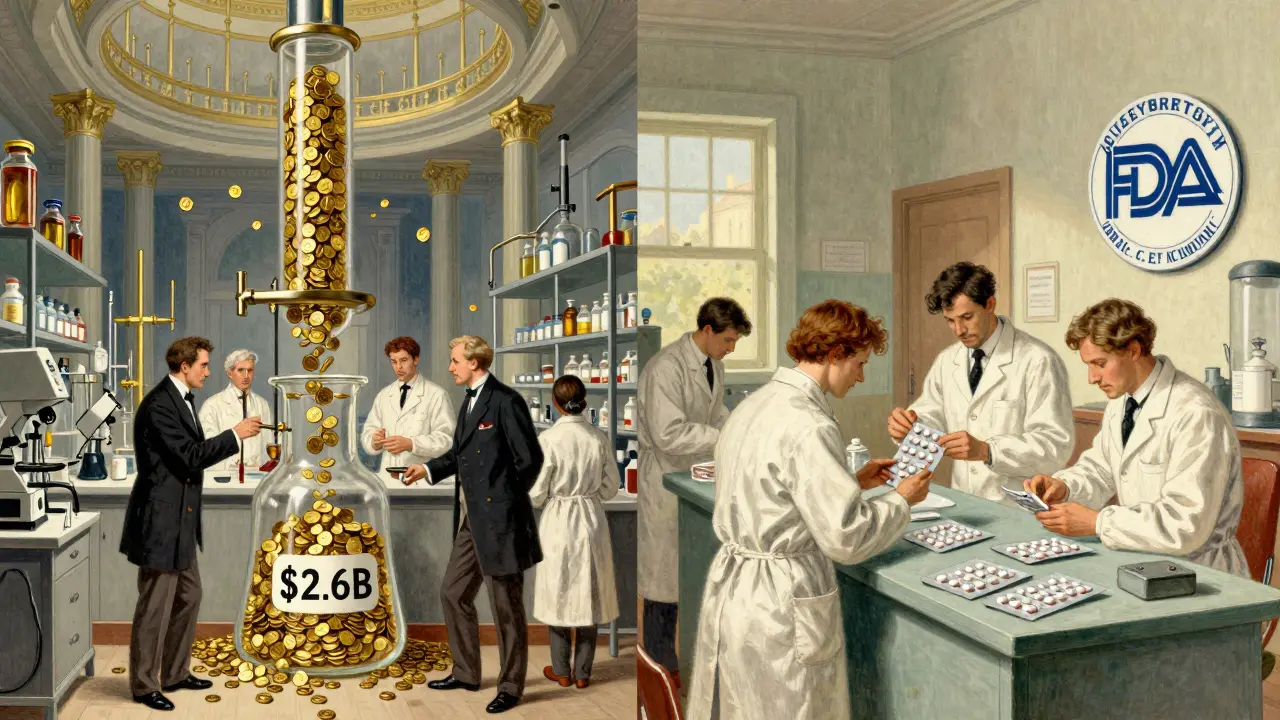
When a pharmaceutical company invents a new drug, they’re not just mixing chemicals in a lab. They’re betting billions on a single molecule. The average cost to bring a new drug to market? Around $2.6 billion. That’s not marketing fluff-it’s the real number from the Tufts Center for the Study of Drug Development. It includes 8 to 12 years of research, dozens of clinical trials, animal testing, regulatory paperwork, failed attempts, and lawsuits.
Think of it like building a house from scratch. You need architects, engineers, permits, materials, labor, inspections, and you might have to tear down half of it and start over when something doesn’t work. That’s what drug development looks like. And if the drug fails? All that money is gone.
Once the drug finally gets approved by the FDA, the company gets 20 years of patent protection. That’s their chance to make back every penny they spent-and then some. During those two decades, they’re the only ones allowed to sell it. No competition. No price pressure. Just them and their customers.
How Generics Skip the Cost
Now imagine someone else comes along after the patent expires. They don’t need to rebuild the house. They just need to copy the blueprint. That’s what generic manufacturers do. They don’t repeat the animal trials. They don’t run new clinical studies on thousands of patients. Why? Because the FDA already knows the active ingredient works. The science is settled.
Instead, generic companies only need to prove one thing: bioequivalence. That means their version delivers the same amount of the active ingredient into your bloodstream at the same speed as the brand-name drug. The FDA requires this difference to be within 80% to 125%-a tight range. In real terms? It’s like two identical cars with the same engine, but one has slightly different seat covers. The performance? Exactly the same.
That’s it. No billion-dollar trials. No 10-year development cycles. Generic manufacturers spend between $1 million and $5 million per drug to get approval. That’s less than 0.2% of what the brand-name company spent.
Same Rules, Different Price
You might think: if generics are cheaper, maybe they cut corners on quality. But that’s not true. The FDA holds generic manufacturers to the exact same standards as brand-name ones. Every facility-whether it’s in the U.S., India, or China-must pass the same inspections. The FDA conducts about 12,000 inspections a year worldwide, and they don’t treat generics any differently.
Generics must meet the same purity, strength, stability, and shelf-life requirements. They must stay within 90% to 110% of their labeled potency for the entire time they’re on the shelf. The only differences you’ll notice? The color, shape, or flavor. Those are changed to avoid trademark infringement. The active ingredient? Identical.
Dr. Henry C. Burgess, Chief Pharmacy Officer at University Hospitals, puts it simply: “A generic drug is a bioequivalent-a chemical copy-of the original brand-name medication. It must be made with the same active ingredient(s), work the same way and provide the same benefit(s).”
Competition Drives Prices Down
Once a patent expires, it’s not just one generic company that jumps in. It’s often 10, 15, even 20. The first one might charge 30% less. The second one drops it to 50%. By the time five companies are selling the same pill, the price crashes.
The Congressional Budget Office found that within the first year of generic entry, prices drop by 80% to 90%. And they keep falling. Tebra’s 2023 survey showed that generic atorvastatin costs 99% less than Lipitor. Omeprazole (Prilosec) went from $300 a month to $6. That’s not a discount. That’s a revolution.
And it’s not just saving patients money-it’s saving the whole system. In 2022 alone, generics saved the U.S. healthcare system $293 billion. From 2007 to 2016, they saved $1.67 trillion. That’s more than the GDP of most countries.
Why People Still Don’t Trust Them
Despite all the data, many people still hesitate. Tebra’s survey found that 62% of Americans trust brand-name drugs more-even though 84% admit generics are just as effective. Why? Because of appearance. You’re used to your blue pill. Now it’s white. Or oval instead of round. You start wondering: Is this the same?
Some patients report feeling different after switching. A Reddit user said their ADHD symptoms worsened after switching from Concerta to generic methylphenidate. But here’s the catch: the FDA has investigated hundreds of these cases. In nearly every instance, the issue wasn’t the drug-it was the placebo effect, inconsistent dosing between different generic brands, or underlying health changes.
There are rare exceptions. Drugs like warfarin, levothyroxine, and phenytoin have a narrow therapeutic index. That means even tiny differences in blood levels can matter. For these, some doctors prefer to stick with one brand or generic manufacturer. But even then, the FDA says all approved generics are safe. The problem isn’t the drug-it’s switching back and forth between different generics too often.
Insurance and What You Can Do
Most insurance plans encourage generics by putting them in the lowest-cost tier. Your copay might be $5 for a generic, $40 for the brand. If you ask for the brand, your insurer will often deny coverage unless your doctor files a special request.
Pharmacists are trained to substitute generics automatically in 49 states. They’re also supposed to spend 3 to 5 minutes explaining the switch. If they don’t, ask. Ask why the pill looks different. Ask if it’s the same. Ask if there’s any reason not to use it.
And if you’ve had a bad experience? Tell your doctor. But don’t assume it’s the generic’s fault. Many times, it’s just your body adjusting-or your mind reacting to a change in appearance.
The Bigger Picture
Generics aren’t a loophole. They’re a necessary part of the system. Without them, millions of people couldn’t afford their meds. One in four Americans skips doses because of cost. Generics keep them alive.
Right now, 90.5% of all prescriptions filled in the U.S. are generics. But they only make up 18% of total drug spending. That’s the power of competition. That’s the power of science. That’s the power of letting people live without choosing between food and medicine.
The next time you see a generic on your receipt, don’t think of it as a second choice. Think of it as the smart choice. The same medicine. The same results. A fraction of the cost.