
The Federal Circuit Court doesn’t just hear appeals-it shapes the future of medicine in the U.S. Every time a generic drug company files paperwork to bring a cheaper version of a brand-name drug to market, the Federal Circuit is quietly deciding whether that move is legal. This isn’t about routine court business. It’s about who gets to sell life-saving drugs, how long they stay expensive, and who pays for them.
Why the Federal Circuit Controls Pharmaceutical Patents
In 1982, Congress created the U.S. Court of Appeals for the Federal Circuit to fix a broken system. Before then, patent cases were scattered across 12 regional appeals courts. One court might say a drug patent was valid; another might say it wasn’t. Companies couldn’t plan. Investors couldn’t trust the rules.
The Federal Circuit changed that. It became the only court in the country that hears every patent appeal-no exceptions. That includes every single pharmaceutical patent case. Whether it’s a new cancer drug, a cholesterol pill, or a biosimilar for rheumatoid arthritis, if it’s about a patent, it goes to the Federal Circuit.
This isn’t just convenience. It means one set of judges, with deep expertise in patent law, sets the standard for the entire industry. That creates predictability-but also a kind of legal monoculture. When every patent case flows through one court, that court’s thinking becomes the law.
How ANDA Filings Trigger Nationwide Lawsuits
Here’s where things get real for drug makers. When a generic company wants to sell a cheaper version of a brand-name drug, it files an Abbreviated New Drug Application, or ANDA, with the FDA. That’s not just paperwork. Under the Hatch-Waxman Act, it’s a legal trigger.
In 2016, the Federal Circuit ruled in Mylan v. AstraZeneca that filing an ANDA counts as an act of infringement nationwide-even if the generic company has no physical presence in the state where the patent holder sues. That decision flipped the script. Before, patent holders had to prove the generic company was selling or shipping drugs in a specific state. Now, just filing the application gives the patent holder the right to sue anywhere.
The result? Delaware became the go-to court for pharmaceutical patent lawsuits. Why? Because it’s friendly to patent holders. Between 2017 and 2023, 68% of ANDA cases were filed there. That’s up from 42% in the decade before. Generic companies now face lawsuits in states where they’ve never sold a pill. The cost? Average litigation expenses jumped from $5.2 million to $8.7 million per case.
The Orange Book and the Rules of Listing
The Orange Book-officially called Approved Drug Products with Therapeutic Equivalence Evaluations-is the secret weapon of brand-name drug companies. It’s a list published by the FDA that shows which patents cover which drugs. If a patent isn’t listed, a generic company can skip challenging it.
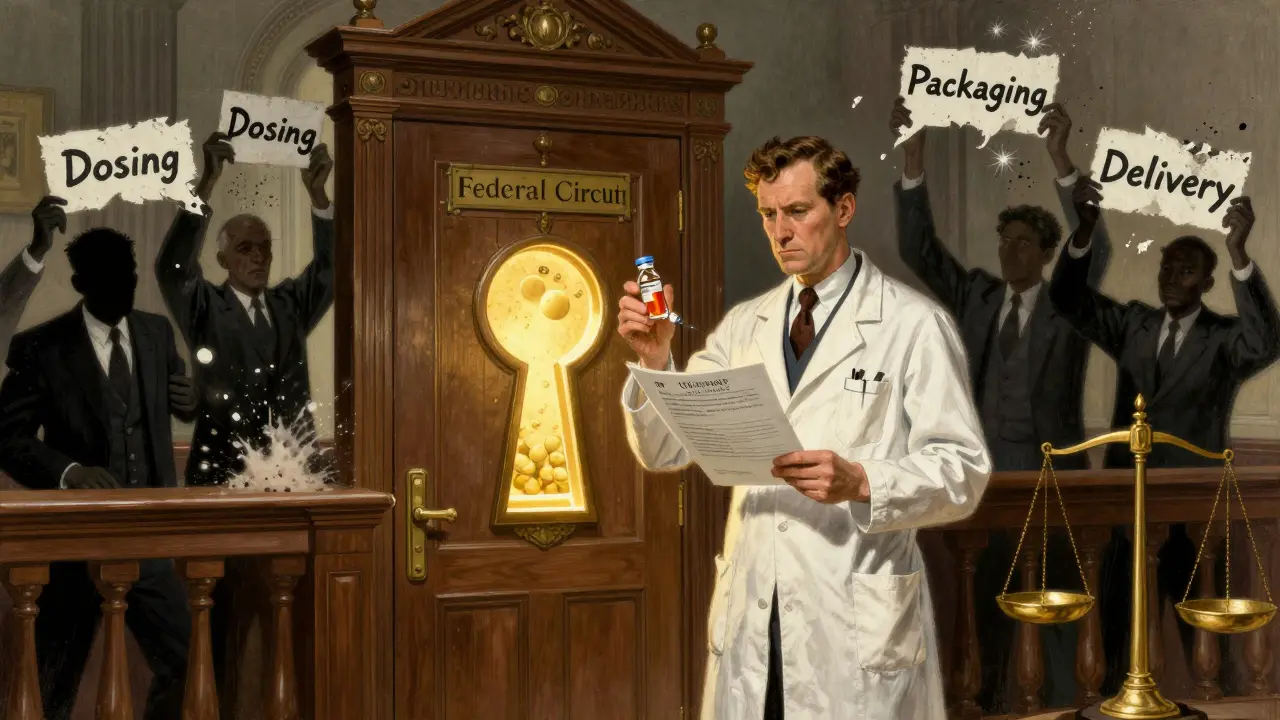
In December 2024, the Federal Circuit clarified the rules in Teva v. Amneal. The court said: if a patent doesn’t actually claim the drug itself, it can’t stay on the Orange Book. No more sneaky listings. No more padding the list with patents that cover delivery methods, packaging, or unrelated uses. The patent must claim the active ingredient in the drug.
This ruling forced big pharma to clean up their patent portfolios. Companies now spend weeks mapping each patent to the exact drug formulation. Legal review time for Orange Book listings went up by 17 business days, according to a 2024 survey of top pharmaceutical firms. It’s more work-but it’s fairer. Generic companies can now see exactly which patents they need to fight.
Why Dosing Patents Are Harder to Get
One of the biggest battlegrounds is dosing. Can you patent a new way to take a drug? Like “take one pill every other day instead of daily”? For years, companies tried. They called it a “method of treatment.” The Federal Circuit said: not enough.
In April 2025, the court ruled in ImmunoGen v. Sarepta that changing the dose of a known drug isn’t automatically patentable. The court said: if the drug itself is already known, and the new dose just follows from what a skilled scientist would try, then it’s obvious. No patent.
That decision sent shockwaves through R&D labs. Before, companies could file dozens of secondary patents on dosing schedules. Now, they’re cutting back. A Clarivate analysis showed a 37% drop in dosing-related patent filings after the ruling. Instead, companies are investing more in entirely new compounds. That’s a win for competition-but a blow to “evergreening,” the practice of extending monopoly life with minor tweaks.
Standing: Can You Challenge a Patent Before You Even Start?
Here’s the catch: you can’t just walk into court and say, “I think this patent is invalid.” You need standing. You need to prove you’re actually planning to make the drug and that the patent is blocking you.
In May 2025, the court ruled in Incyte v. Sun Pharma that vague intentions aren’t enough. You need documents: clinical trial plans, manufacturing agreements, FDA correspondence. One judge, Hughes, pointed out the irony: the court keeps saying generic companies need to prove they’re serious-but then it makes it harder for them to prove it.
Patent attorneys now advise clients to start documenting development activities early. Phase I trial protocols, supply contracts, internal memos about drug formulation-all of it matters. Without them, you can’t even get in the door to challenge a patent. That’s a huge barrier for smaller generic companies with limited legal budgets.
How This Affects Patients and Prices
Behind every legal decision is a real-world cost. The Federal Circuit’s rulings have slowed down generic drug entry. The 30-month stay on generic approval? It’s now almost always used up. That means patients wait longer for cheaper drugs.
But it’s not all bad. The court’s strict rules on dosing patents and Orange Book listings have forced brand companies to focus on real innovation-not just tweaking old drugs. Biologics, the new wave of complex drugs like insulin and cancer antibodies, are seeing more competition now too. The court extended the same jurisdiction rules to biosimilars in 2020, and litigation in that space has jumped 300% since.
Patent holders still win most of the time. The court affirms the validity of core compound patents in 82% of cases. But the days of padding patent portfolios with weak, dosing-based claims? Those are over.
What’s Next?
Congress is watching. Senators Tillis and Coons introduced the Patent Quality Act of 2025 to fix the standing problem. They argue the court’s current rules hurt competition. If passed, it could make it easier for generic companies to challenge patents before spending millions on development.
For now, the Federal Circuit remains the single most powerful court in U.S. pharmaceutical law. Its decisions don’t just settle lawsuits-they determine which drugs reach shelves, how much they cost, and who gets access. If you’re a patient, a generic manufacturer, or even a brand-name company, you’re living under the rules this court writes.
Why does the Federal Circuit have exclusive control over pharmaceutical patent cases?
The Federal Circuit was created by Congress in 1982 to centralize all patent appeals. Before that, different regional courts made conflicting rulings on patents, creating chaos for drug companies. Now, every patent case-from cancer drugs to generic pills-goes to this one court. This ensures consistent rules across the entire U.S. pharmaceutical industry.
What is an ANDA and why does it matter in patent lawsuits?
An ANDA, or Abbreviated New Drug Application, is the paperwork a generic drug company files with the FDA to get approval to sell a cheaper version of a brand-name drug. Filing an ANDA triggers a legal action under the Hatch-Waxman Act. The Federal Circuit ruled that this filing alone counts as an act of infringement nationwide, letting patent holders sue in any state-even if the generic company has no physical presence there.
How does the Orange Book affect generic drug approvals?
The Orange Book is the FDA’s official list of patents tied to brand-name drugs. If a patent isn’t listed, a generic company doesn’t have to challenge it. The Federal Circuit ruled in 2024 that only patents that actually claim the drug’s active ingredient can stay on the list. This prevents companies from listing weak or unrelated patents to delay generics, making the approval process more transparent and fair.
Can you patent a new way to take a drug, like a different dosage schedule?
It’s much harder now. In 2025, the Federal Circuit ruled that changing the dose of a known drug isn’t enough for a patent unless it produces unexpected results. If the drug is already known and the dosage is just a logical variation, it’s considered obvious. This has led to a 37% drop in dosing-related patent filings since the decision.
Do generic companies need to prove they’re serious before challenging a patent?
Yes. The Federal Circuit requires “standing”-proof that the generic company is actively developing the drug. That means having clinical trial plans, manufacturing agreements, or FDA correspondence. Vague intentions aren’t enough. This rule makes it harder for small companies to challenge patents before spending millions, raising concerns about reduced competition.




Solomon Ahonsi
February 3 2026This court is a patent troll’s wet dream. One group of judges deciding everything? No wonder generics can’t breathe. They’re not fixing the system-they’re locking it down for Big Pharma. Patients pay the price while lawyers get rich. It’s not justice, it’s a monopoly machine.