
Every year, millions of pregnant women turn to the internet to find out if a medication is safe. They read forum posts, scroll through Instagram reels, click on blog articles, and watch YouTube videos. But here’s the hard truth: over 40% of online advice about medications in pregnancy is inaccurate. A 2019 study analyzed more than 1,400 medication scenarios shared online and found that only 57% matched the gold-standard guidelines from Teratology Information Services (TIS). That means nearly half the time, someone is getting advice that could put their health-or their baby’s-at risk.
Why does this happen? Because the internet doesn’t care if your advice is right. It cares if it gets clicks. A post saying "Never take ibuprofen while pregnant" might get 10,000 shares-even if the latest study shows it’s safe in the second trimester. Meanwhile, a nuanced, evidence-based explanation from a medical journal gets buried under memes and fear-driven headlines.
What Makes Online Advice Reliable?
Not all sources are created equal. The difference between a trustworthy site and a dangerous one comes down to three things: who wrote it, what they cite, and when they updated it.
Start with the source. If the website ends in .gov or .edu, that’s a strong first sign. The National Library of Medicine runs LactMed, a free database updated every week with data on drugs in breast milk and pregnancy. The Organization of Teratology Information Specialists (OTIS) runs MotherToBaby, a service backed by the U.S. government and staffed by board-certified specialists. These are not blogs. These are research-backed, peer-reviewed resources.
On the other hand, commercial sites-like those run by supplement companies, pharmacies, or even some big health portals-often mix facts with marketing. A 2023 review found that only 38.7% of commercial websites gave a full risk-benefit analysis. Many just say "safe" or "avoid" without explaining why. Some even hide their funding: 42% of "educational" sites have undisclosed ties to drug manufacturers, according to a 2024 study in Frontiers in Global Women’s Health.
The Gold Standard: Teratology Information Services (TIS)
If you want to know whether a medication is safe during pregnancy, you need to understand TIS categories. They’re not complicated, and they’re used by every specialist who advises pregnant women.
- Safe: No known risk in human studies. Examples: paracetamol (acetaminophen), folic acid.
- Contraindicated: Proven harm. Examples: isotretinoin (Accutane), thalidomide.
- On strict indication or second-line: Use only if benefits clearly outweigh risks. Examples: lamotrigine (for epilepsy), certain antidepressants like sertraline.
- Insufficient knowledge: Not enough human data. Examples: many newer medications, herbal supplements.
Here’s the kicker: when people read about a drug in the "strict indication" category online, they often think it’s dangerous. But that’s not what it means. It means: "This isn’t first choice, but if you need it, it’s still safer than not treating your condition." For example, untreated depression during pregnancy can be riskier than taking sertraline. Yet 93% of social media posts misclassify these drugs as "unsafe."
Check the Evidence-Not the Hype
Good advice doesn’t say "studies show." It says which studies, who did them, and what they found.
Take paracetamol. In 2021, a study in JAMA Internal Medicine followed 95,000 pregnancies and found no link between paracetamol use and autism or ADHD. That’s solid. But if a blog says, "Paracetamol causes birth defects," and cites a 1998 animal study, that’s not evidence-it’s noise.
Real evidence includes:
- Study name and journal
- Number of participants
- Control group details
- Limitations (e.g., "This study only looked at first-trimester use")
If you see vague phrases like "many women report" or "experts warn," walk away. Real science doesn’t speak in whispers. It names names.

Age Matters-A Lot
Drug safety knowledge changes fast. A label from 2010 might say "Category C," which means "risk can’t be ruled out." But since 2015, the FDA replaced those vague letters with detailed summaries under the Pregnancy and Lactation Labeling Rule (PLLR). So if a site still uses A, B, C, D, X categories, it’s outdated.
Experts agree: anything older than two years should be treated with caution. A 2023 NIH webinar pointed out that 78% of standard drug labels contain outdated teratogenic risk info. That’s because research moves faster than packaging. A 2020 study might say a drug is risky. A 2024 study with 10x more data might say it’s safe. If the site doesn’t mention when it was last updated, assume it’s stale.
Five Steps to Check Any Online Claim
Here’s your simple, five-step system. It takes less than 30 minutes-and it could save you from stopping a medication you actually need.
- Check the source - Is it .gov, .edu, or MotherToBaby? If it’s a company site, look for HONcode certification (a seal for ethical health info).
- Verify the author - Look for credentials: OB-GYN, clinical pharmacist, or teratologist. Cross-check names on the American Board of Medical Specialties website.
- Find the citation - Does it link to a real study? Click it. Does the study have a DOI? Does it mention sample size and limitations? If it just says "a study found," skip it.
- Check the date - Is the information less than two years old? If not, look for newer sources.
- Compare with three trusted sources - Cross-check with LactMed, OTIS/MotherToBaby, and ACOG guidelines. If they all say the same thing, you’re safe. If they conflict, call a specialist.
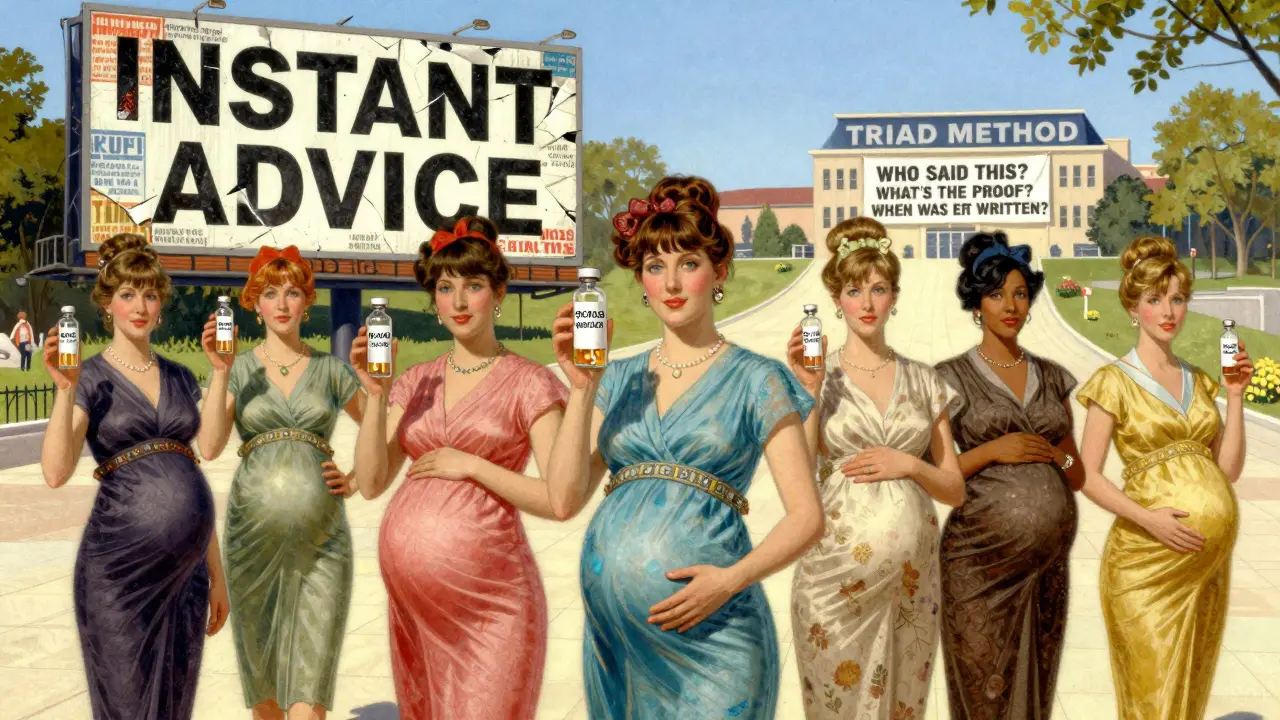
This is called the TRIAD method: Teratology database, Review primary literature, Assess date.
What About Natural Remedies?
"Natural" doesn’t mean safe. In fact, it often means the opposite. A 2024 study found that 63% of pregnant women believed herbal supplements were FDA-approved. They’re not. The FDA doesn’t review supplements for safety or effectiveness before they hit the shelf. That’s why you see products labeled "safe for pregnancy" with zero clinical data.
Chamomile tea? Probably fine. But ginger pills? They can affect blood clotting. Black cohosh? Linked to liver damage. Licorice root? May raise blood pressure. Always treat supplements like drugs-because they are.
When in Doubt, Call a Specialist
Even doctors don’t always know the latest data. That’s why services like MotherToBaby exist. They have pharmacists and specialists on call 24/7. You can call 1-866-626-6847 anytime, day or night. No appointment. No cost. Just real answers.
The FDA also offers a free Drug Safety Podcast, updated every two weeks. It’s short, clear, and covers exactly what you need: "Is this medication safe in pregnancy?"
The Bigger Picture
This isn’t just about one pill or one post. It’s about trust. When women are scared, they stop taking medications they need. A 2024 Reddit analysis found 87 cases where women stopped antidepressants after reading false advice-29 of them ended in emergency psychiatric care. That’s not a coincidence. That’s systemic misinformation.
But there’s hope. A 2025 study in Journal of Medical Internet Research gave women a 4.2-hour online course on how to evaluate medication advice. Afterward, their ability to spot accurate sources jumped by 15.7%. Confidence went from 52.3 to 68.0 on a 100-point scale. That’s not magic. That’s education.
And the tools are getting better. In late 2025, the University of Washington launched a beta API that instantly scores the credibility of any pregnancy medication claim-with 91.3% accuracy. The FDA’s new Digital Health Precertification Program, rolling out in 2026, could cut misinformation by 60% by requiring apps to prove their advice is evidence-based before they’re sold.
For now, though, you’re your own best defense. You don’t need to be a doctor. You just need to ask: Who said this? What’s the proof? When was it written? And if you’re unsure-call someone who knows.
Can I trust advice from Facebook groups or Reddit threads about pregnancy medications?
No-not reliably. A 2022 study found that 93% of social media posts about medications in the "strict indication" category were misclassified as unsafe. Reddit threads like r/BabyBumps have over 1 million members, but they’re full of personal stories, not science. One woman’s experience with a medication doesn’t mean it’s safe or dangerous for everyone. Always verify claims with official sources like MotherToBaby or LactMed before making any changes.
What’s the difference between FDA Pregnancy Categories and the current PLLR system?
The old A, B, C, D, X categories were vague and misleading. Category C meant "risk can’t be ruled out," but didn’t explain how likely or severe that risk was. Since 2015, the FDA replaced them with the Pregnancy and Lactation Labeling Rule (PLLR), which gives detailed summaries: risks based on human data, animal studies, dosing info, and clinical considerations. If a site still uses A-B-C-D-X labels, it’s outdated. Always look for the newer, narrative-style summaries.
Are herbal supplements safe during pregnancy just because they’re "natural"?
No. The FDA doesn’t test herbal supplements for safety or effectiveness before they’re sold. A 2024 study found 63% of pregnant women wrongly believed they were approved. Some herbs-like black cohosh or licorice root-can cause serious problems. Others, like ginger, are generally safe in food amounts but risky in concentrated pill form. Always check LactMed or call MotherToBaby before taking any supplement.
Why do some doctors give conflicting advice about pregnancy medications?
Because the science changes quickly. A 2020 guideline might say avoid a drug, but a 2023 study with 50,000 patients might show it’s safe. Many doctors don’t have time to keep up. That’s why expert services like OTIS exist-to bridge the gap between research and practice. If your doctor says "avoid" but you find recent studies saying otherwise, ask for the source. If they can’t point to a study, ask for a referral to a teratologist or pharmacist.
How can I tell if a website is secretly sponsored by a drug company?
Look for hidden disclosures. Many sites say "sponsored by" in tiny print at the bottom. Others don’t say anything. Check the "About Us" page-does it list pharmaceutical partners? Search the FDA’s Warning Letters database for the company name. If the site pushes one drug heavily without mentioning alternatives, or uses emotional language like "don’t risk your baby," it’s likely marketing. Trusted sites like MotherToBaby or NIH don’t promote products-they give facts.




Virginia Kimball
February 15 2026Okay but let’s be real - the internet is a dumpster fire and pregnant people are just trying to survive without getting ghosted by their OB’s office. I found a Reddit thread that said avoid ibuprofen entirely, so I panicked and stopped taking it for my migraine. Then I called MotherToBaby and they were like, ‘It’s fine in the second trimester, babe.’ I cried. Not because I was scared, but because I realized I didn’t have to be terrified all the time. You don’t need a medical degree to be smart about this. You just need to ask one question: ‘Who benefits if I believe this?’