
Every year, more than 1.5 million people in the U.S. suffer harm from medication errors. Many of these mistakes happen not because a doctor prescribed the wrong drug, but because no one had the full picture of what the patient was actually taking. A simple, accurate medication list can stop most of these errors before they start. It’s not just for hospitals or clinics-it’s something every patient should keep, update, and share. And it’s not as hard as you think.
Why Your Medication List Matters More Than You Realize
Think about the last time you visited a new doctor, went to the ER, or got discharged from the hospital. Did they ask what medicines you take? Probably. But did they get the full answer? Most patients forget something-maybe that daily aspirin, the turmeric supplement, or the eye drops they use for dry eyes. These gaps are dangerous. According to research from Harvard Medical School, patients who keep a complete, up-to-date list reduce their risk of adverse drug events by 43%. That’s not a small number. It’s the difference between going home after a hospital stay and coming back because of a bad reaction. The problem isn’t just forgetfulness. A 2024 study found that 73% of patient-reported medication lists had at least one major mistake-missing drugs, wrong doses, or outdated instructions. Even if you think you remember everything, your memory isn’t reliable under stress. That’s why a written or digital list isn’t optional. It’s your safety net.What Belongs on a Complete Medication List
A good list doesn’t just say “I take blood pressure medicine.” It gives providers the exact details they need to make safe decisions. Here’s what you need to include for every medication:- Medication name-both generic and brand (e.g., lisinopril, brand name Zestril)
- Dosage-exactly how much (e.g., 10 mg, not “one pill”)
- How and when to take it-e.g., “once daily with breakfast,” “as needed for pain, up to 3 times a day”
- Why you take it-e.g., “for high blood pressure,” “for arthritis pain”
- When you started-month and year
- Who prescribed it-doctor’s name or clinic
- Refill status-how many left, when you need a new one
Don’t forget the non-prescription stuff. That includes:
- Over-the-counter drugs (ibuprofen, antacids, sleep aids)
- Vitamins and minerals (vitamin D, iron, B12)
- Herbal supplements (st. john’s wort, ginkgo, garlic pills)
- Topical treatments (creams, patches, eye drops, inhalers)
And don’t skip your allergies. Write them clearly: “Amoxicillin-rash and swelling,” not just “allergic to penicillin.” Specifics matter. If you’ve ever had a reaction, even a mild one, write it down.
Paper or Digital? Which Format Works Best
You have options. And the best one is the one you’ll actually use and update. About 68% of patients still use a paper list. That’s fine-if it’s legible, always with you, and updated. Use a notebook or printed template. The FDA recommends a minimum 12-point font if you’re handwriting it. Keep it in your wallet, purse, or phone case. Take a photo of it too, so you have a backup. Digital tools are growing fast. GoodRx reports that 42% of their 150 million users now use their medication list feature. Apps like Medisafe and MyTherapy let you set reminders, track refills, and even share your list with doctors through secure portals. Many EHR systems now let you view and update your own medication list online. The key is consistency. If you use an app, make sure it syncs with your phone and has cloud backup. If you use paper, keep a copy at home and another in your bag. Never rely on memory alone.How to Build Your List (Step by Step)
Creating your list doesn’t have to be overwhelming. Here’s how to do it in under 30 minutes:- Gather everything. Pull out all your pill bottles, supplement containers, and topical meds. Don’t skip the ones you only use occasionally.
- Write it down. Use the format above for each item. If you’re unsure about a drug’s name or dose, call your pharmacy-they have the full record.
- Check for gaps. Did you forget the daily aspirin? The eye drops? The melatonin you take when you can’t sleep? Add them.
- Verify with your pharmacy. Call your pharmacy and ask for a full list of everything they’ve filled for you in the last year. Compare it to your list. Fix any differences.
- Print or save it. Make two copies-one for your wallet, one for your home file. If using an app, set it to auto-backup.
Do this once, and you’ll never have to start from scratch again. Just update it whenever something changes.

When and How to Update Your List
Your list isn’t a one-time task. It’s a living document. Update it immediately when:- A doctor adds, removes, or changes a medication
- You stop taking something-even if you just didn’t like the side effects
- You start a new supplement or OTC drug
- You switch pharmacies or doctors
Don’t wait for your next appointment. Write it down the same day. If you use an app, update it right after your call with the doctor. If you use paper, keep a pen next to your list.
Also, schedule a dedicated medication review once a year. Don’t try to squeeze it into a quick checkup. A 2023 study found that 68% of medication discussions during regular visits get cut short. Book a 15-minute appointment just to go over your list with your primary care provider. Bring your list. Ask: “Is this still right? Are any of these drugs interacting?”
Special Cases: Complex Regimens and PRN Medications
If you take five or more medications, things get trickier. Color-coding helps. Use a different color pen or highlighter for each condition: blue for heart meds, green for pain, red for supplements. Some clinics even give patients icons-like a heart for blood pressure, a brain for antidepressants. As-needed (PRN) meds are often forgotten. These include painkillers, anxiety pills, or inhalers you only use sometimes. List them separately with clear instructions: “Albuterol inhaler: 2 puffs when short of breath, max 8 times per day.” A 2023 study from Advanced Psychiatry Associates showed that patients using color-coded or icon-based lists improved their adherence by 27%. That means they actually took their meds as prescribed-and avoided avoidable trips to the hospital.What Happens When You Don’t Keep a List
Skip the list, and you’re playing Russian roulette with your health. - You might get a drug that interacts with something you’re already taking. For example, St. John’s wort can make blood thinners like warfarin useless-or dangerously strong. - You might get duplicate prescriptions. Two doctors might prescribe the same drug without knowing the other did. - You might be given a drug you’re allergic to. A 2023 report found incomplete medication histories caused 36.7% of all preventable adverse drug events during hospital admissions. - You might be discharged from the hospital with the wrong meds. That’s a leading cause of readmissions. The cost? Not just in health. In the U.S., medication errors add $3.5 billion to medical bills every year. And half of those errors happen during transitions between care settings-like when you leave the hospital or switch doctors.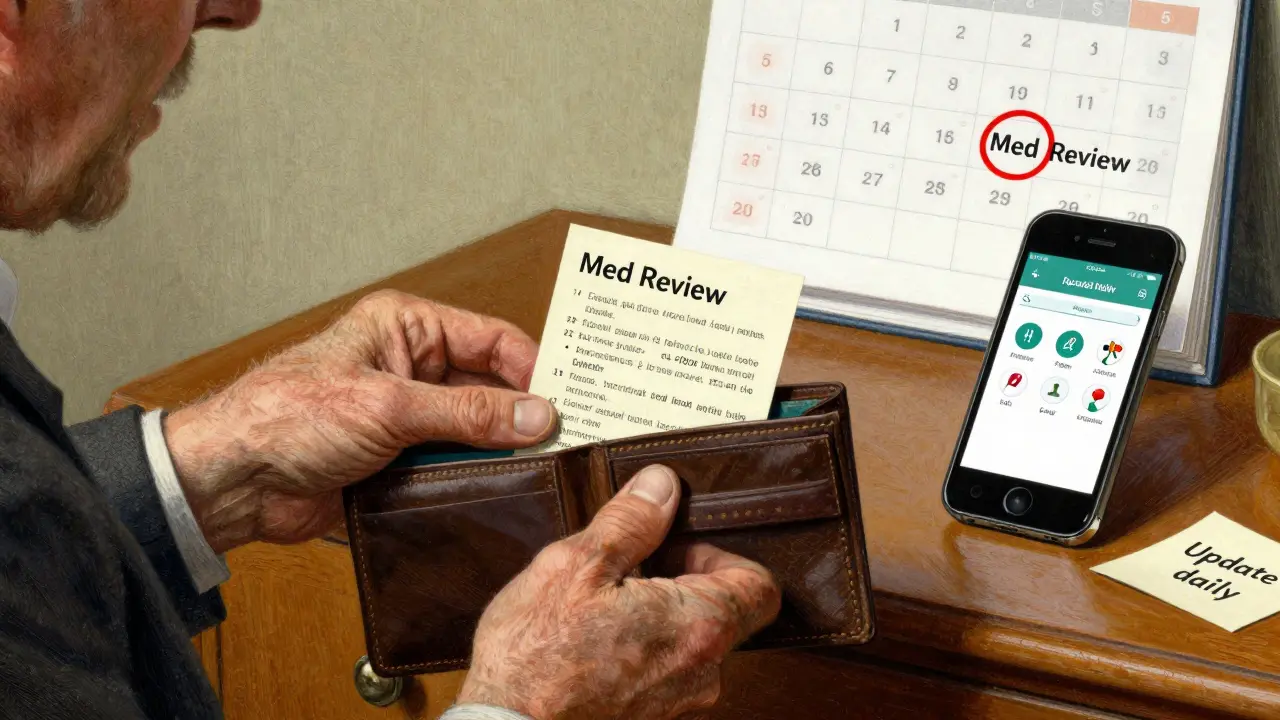
How Providers Use Your List
Your list isn’t just for you. It’s a communication tool for your whole care team. When you walk into a clinic, your doctor uses your list to:- Check for dangerous interactions
- Decide if a new prescription is safe
- Understand why you’re not improving (maybe you stopped a drug)
- Coordinate with specialists
Hospitals use it for “medication reconciliation”-a formal process where staff compare your list to what’s in the system. The ECRI Institute found that lists with all the right details reduce reconciliation errors by 78%.
And it’s not just about safety. Practices that use EHR-integrated patient lists see 40% higher compliance with list updates. That means doctors spend less time calling pharmacies and more time helping you.
Barriers and How to Overcome Them
Not everyone finds this easy. Here are common roadblocks-and how to beat them:- “I forget OTC meds.” Keep a small notepad in your bathroom or kitchen. Jot down every pill you take, even if it’s just for a cold.
- “I don’t understand the names.” Call your pharmacy. Ask them to print out a plain-language list. Most will do it for free.
- “I’m not tech-savvy.” Paper is still valid. Use a template from the FDA’s “My Medicines” guide. Print it, fill it out, and keep it handy.
- “I don’t have time.” Set a calendar reminder: “Med list update-first Sunday of every month.” It takes 10 minutes.
There’s also a big gap in access. Only 38% of Medicare beneficiaries keep updated lists, compared to 67% of commercially insured patients. Rural patients are over twice as likely to lack complete records. If you’re in this group, ask your clinic for help. Many now offer free medication reviews.
What’s Changing in 2026
The system is getting better. Thanks to the 21st Century Cures Act, all certified electronic health records must now give you direct access to your medication list. As of April 2024, 92% of major health systems comply. New standards like the HL7 FHIR Medication Knowledge Guide make it easier for different systems to share your list securely. And by 2027, the government wants everyone to have a single, consolidated medication record. Meanwhile, apps are getting smarter. Some now sync with your pharmacy’s refill system and send alerts when you’re due for a checkup. Others use AI to flag possible interactions before you even ask. But the most important change? You’re in control now. You’re no longer just a patient who shows up with a bottle of pills. You’re the keeper of your own safety record.Final Checklist: Is Your List Ready?
Before your next appointment, ask yourself:- Do I have every prescription, OTC drug, vitamin, and supplement listed?
- Is the dosage exact? (Not “one pill,” but “10 mg”)
- Do I know why I take each one?
- Is my allergy list specific?
- Do I have a copy with me? And a backup at home?
- Was it updated in the last 30 days?
If you answered yes to all, you’re doing better than most. If not, fix one thing today. Update one drug. Add one supplement. Call your pharmacy. It’s the easiest way to protect your health.
What if I don’t know the name of a medication on my pill bottle?
Call your pharmacy. They have your full prescription history and can tell you the generic and brand names. You can also use apps like GoodRx or Drugs.com to scan the pill’s imprint code. Most pharmacies will print you a free, easy-to-read list.
Do I need to list vitamins and supplements?
Yes. Many supplements interact with prescription drugs. For example, St. John’s wort can reduce the effectiveness of birth control pills and antidepressants. Garlic and ginkgo can increase bleeding risk during surgery. Your doctor needs to know everything you’re taking-even if you think it’s “natural” and harmless.
Can I just tell my doctor what I take during my visit?
It’s risky. Studies show patients forget at least one medication 73% of the time, even when they think they remember everything. Stress, time limits, and distractions make memory unreliable. A written list ensures nothing gets missed.
How often should I update my medication list?
Update it immediately after any change: new prescription, stopped drug, new supplement, or change in dosage. Also, do a full review once every three months. Even if nothing changed, it’s a good habit to check for outdated info or expired meds.
What if I use multiple pharmacies?
That’s common. Ask each pharmacy for a complete list of what they’ve filled for you. Then combine them into one master list. Use your primary care provider’s portal if available-many now pull data from multiple pharmacies automatically.
Is there a free template I can use?
Yes. The FDA’s “My Medicines” tool offers a free printable template with all the required fields. You can find it on the FDA’s website under “Patient Safety.” It’s designed for all ages and includes space for allergies, emergency contacts, and pharmacy info.



Josh josh
January 27 2026man i just keep my meds in a ziplock in my wallet with the original bottles lol
its messy but i know what each one is cause i can pull em out and read em
paper lists? nah bro i dont trust paper