
Living with irritable bowel syndrome (IBS) means dealing with bloating, cramps, diarrhea, or constipation that seem to come out of nowhere. You’ve tried cutting out gluten, skipping dairy, or eating more fiber-yet nothing sticks. What if the problem isn’t just what you eat, but how your body reacts to certain carbs? That’s where the FODMAP diet, low-residue diet, and elimination plans come in. These aren’t fads. They’re science-backed tools designed to help you find your personal food triggers and take back control of your gut.
What Is the Low-FODMAP Diet, and Why Is It the Gold Standard?
The low-FODMAP diet isn’t about cutting out carbs entirely. It’s about targeting a specific group of short-chain carbohydrates that your gut struggles to absorb. FODMAP stands for Fermentable Oligosaccharides, Disaccharides, Monosaccharides, And Polyols. These include things like onions, garlic, wheat, apples, honey, and artificial sweeteners like sorbitol. When they reach your large intestine, gut bacteria ferment them, producing gas and drawing in water-leading to bloating, pain, and changes in bowel habits.
Developed by researchers at Monash University in Australia, this diet has been tested in over 20 clinical trials involving nearly 2,000 people. The results? Between 75% and 80% of IBS patients see significant improvement in symptoms. That’s far higher than generic advice like “eat more fiber” or “avoid spicy food.” The key is precision. It’s not just “avoid dairy”-it’s “avoid lactose, but you can still have hard cheese.” Not “avoid fruit”-it’s “avoid apples and pears, but bananas and oranges are fine.”
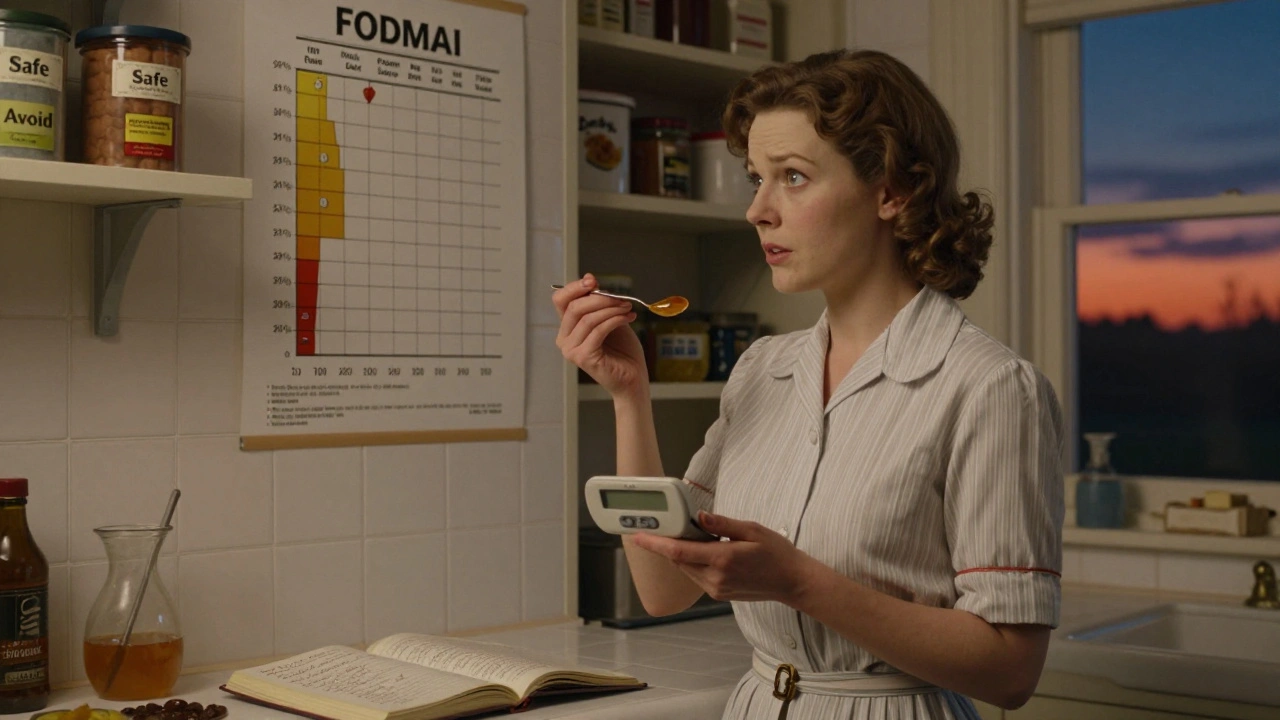
The diet has three phases. Phase 1 is elimination: you cut out all high-FODMAP foods for 2 to 6 weeks. This isn’t a long-term plan. It’s a reset. You’ll use the Monash FODMAP app to check portion sizes-because even a small amount of garlic can trigger symptoms. Phase 2 is reintroduction: you slowly add back one FODMAP group at a time (like fructans or lactose) to see what you tolerate. Phase 3 is personalization: you build a diet around the foods you can eat without symptoms. Most people end up eating 50-80% of the foods they initially cut out. The goal isn’t restriction-it’s freedom.
Low-Residue Diet: When Less Fiber Actually Helps
If your main issue is frequent diarrhea, you might have heard of the low-residue diet. Unlike FODMAP, this isn’t about carbohydrates-it’s about fiber and bulk. A low-residue diet limits fiber to 10-15 grams per day (compared to the recommended 25-38 grams). That means no raw fruits or veggies, no nuts, seeds, whole grains, or legumes. Even cooked vegetables are limited. Dairy is often restricted too, unless it’s lactose-free.
This diet was originally designed for people with inflammatory bowel disease (IBD) before surgery or during flare-ups. But some IBS patients-especially those with diarrhea-predominant IBS (IBS-D)-find relief. Why? Less fiber means less stool volume and faster transit time. One study found 45% of IBS-D patients improved on a low-residue diet, compared to 75% on low-FODMAP. So it’s not as effective overall, but it can be a useful short-term tool if your symptoms are dominated by urgent diarrhea.
But here’s the catch: long-term use is risky. Cutting out fiber-rich foods means missing out on essential nutrients. Calcium intake can drop by 25%, folate by 35%. You’re also eliminating prebiotics that feed good gut bacteria. This diet isn’t meant to be permanent. If you’re considering it, use it for no more than 2-4 weeks and always under professional guidance. It’s not a solution for constipation-predominant IBS (IBS-C)-it’ll make it worse.
General Elimination Diets: Simpler, But Less Precise
Many people try elimination diets before hearing about FODMAP. They cut out common triggers like dairy, gluten, caffeine, or fried foods for 2-4 weeks, then add them back one by one. It sounds logical, and for some, it works. But without structure, it’s guesswork. You might eliminate gluten and feel better-but is it because of gluten, or because you also stopped eating wheat bread (which contains fructans)?
Studies show only 30-40% of people correctly identify their real trigger without professional help. The FODMAP diet’s strength is its standardized approach: specific doses for each FODMAP group, clear timelines, and validated food databases. A general elimination diet might help if you’re on a tight budget or can’t access a dietitian, but it’s not as reliable. It’s like trying to find a needle in a haystack when you don’t know what the needle looks like.
Which Diet Is Right for You?
Let’s break it down:
| Feature | Low-FODMAP Diet | Low-Residue Diet | General Elimination Diet |
|---|---|---|---|
| Primary Goal | Identify fermentable carb triggers | Reduce stool volume | Find food sensitivities |
| Best For | Bloating, pain, mixed IBS | Diarrhea-predominant IBS (short-term) | Simple cases, limited resources |
| Duration | 3-6 months (with phases) | 2-4 weeks max | 2-4 weeks |
| Effectiveness | 75-80% symptom improvement | 40-45% improvement | 40-50% improvement |
| Long-Term Sustainability | High (personalized) | Low (nutrient risks) | Medium (depends on follow-up) |
| Requires Professional Help? | Strongly recommended | Recommended | Optional |
If you have bloating and pain with mixed bowel habits, start with FODMAP. If you’re having explosive diarrhea and need quick relief, a short low-residue trial might help-but only as a bridge, not a solution. If you’re just starting out and can’t access a dietitian, try a basic elimination diet, but be ready to upgrade to FODMAP if it doesn’t work.
What You Need to Succeed
Doing this right takes tools. The Monash FODMAP app is the most trusted resource. It tells you exactly how much of a food is safe to eat. A tablespoon of honey? High-FODMAP. A teaspoon? Low. Without this, you’re flying blind. You’ll also need a digital kitchen scale (accurate to 1 gram) and a symptom journal. Track what you eat, when you eat it, and how you feel-especially during reintroduction.
Hidden FODMAPs are everywhere. Soy sauce, protein bars, salad dressings, even some “healthy” snacks contain inulin, fructose, or polyols. Read labels like a detective. Look for ingredients like: high-fructose corn syrup, honey, agave, inulin, chicory root, sorbitol, mannitol, and xylitol. If you see them, skip it.
And don’t underestimate the social side. Eating out during Phase 1 is hard. But there are workarounds. Carry a Monash FODMAP restaurant card. Choose grilled chicken, plain rice, steamed carrots, and olive oil. Avoid sauces, bread, and desserts. Many restaurants now list low-FODMAP options online. And you’re not alone-over 140,000 people are in the r/FODMAP Reddit community sharing tips and wins.

Common Mistakes and When to Walk Away
The biggest mistake? Skipping Phase 2. People cut out everything, feel better, and never test what they can tolerate. They stay on the strict diet for months-or years-and end up with a shrinking food list and more anxiety. That’s not progress. That’s a trap.
Another mistake: thinking it’s a weight-loss diet. It’s not. You might lose weight because you’re eating less processed food, but that’s a side effect, not the goal.
And if you have a history of disordered eating, this diet isn’t for you. The restrictions can trigger obsessive behaviors. The VA Whole Health Library warns that 15% of IBS patients have contraindications for FODMAP due to eating disorders. If food anxiety is rising, pause. Talk to a therapist or dietitian who specializes in both gut health and mental health.
Also, not everyone responds. About 25% of people see no improvement. That doesn’t mean you’re broken. It might mean your IBS is driven by stress, motility issues, or gut-brain axis dysfunction-not food. In those cases, cognitive behavioral therapy (CBT) or gut-directed hypnotherapy might help more than diet.
What’s Next for IBS Diets?
The field is evolving fast. Monash University just updated its app with AI meal planning and 1,200 new foods. Researchers are testing whether gut bacteria patterns can predict who will respond to FODMAP. Some are even exploring breath tests to measure hydrogen and methane levels after eating-so you don’t have to guess your triggers.
By 2026, many doctors expect FODMAP tracking to be built into electronic health records. Insurance companies are starting to cover dietitian visits for IBS. The goal is no longer just symptom control-it’s personalization. You shouldn’t have to live on a restricted diet forever. You should be able to enjoy a slice of pizza, a bowl of pasta, or a glass of milk without fear.
The truth is, IBS isn’t one condition. It’s many. And your diet should be just as unique as you are. The FODMAP diet gives you the map. The rest is up to you.
Can I do the low-FODMAP diet without a dietitian?
Yes, but it’s harder-and riskier. About 45% of people who try it alone don’t complete the reintroduction phase correctly, which means they miss out on long-term freedom. A dietitian helps you avoid nutrient gaps, interpret symptoms accurately, and navigate tricky foods like sauces and processed items. If you can’t afford one, use the Monash app, join online communities, and track everything. But if you’re not seeing results after 6 weeks, seek professional help.
How long does it take to see results on a low-FODMAP diet?
Most people notice improvement within 2 to 6 weeks of starting the elimination phase. Some feel better in just 10 days. But remember: the goal isn’t just to feel better quickly-it’s to figure out what you can safely eat long-term. Rushing the reintroduction phase can lead to unnecessary restrictions.
Is the low-residue diet safe for long-term use?
No. It’s designed for short-term use only-typically 2 to 4 weeks. Long-term use can lead to nutrient deficiencies, especially in calcium, folate, and fiber. It also reduces beneficial gut bacteria. If you rely on it for more than a month, you risk worsening constipation, weakening your immune system, and increasing your risk of osteoporosis. Use it only as a temporary tool under supervision.
Can I still eat out on a low-FODMAP diet?
Yes, but it takes planning. Stick to simple dishes: grilled meats, plain rice or potatoes, steamed vegetables (like carrots or zucchini), and olive oil. Avoid sauces, dressings, garlic, onions, and bread. Many restaurants now have low-FODMAP options listed online. Carry a Monash FODMAP restaurant card to help staff understand your needs. You’re not asking for a special meal-you’re asking for modifications to standard dishes.
What if the low-FODMAP diet doesn’t work for me?
You’re not alone. About 25% of people don’t respond. That doesn’t mean you’re doing something wrong-it might mean your IBS is triggered by something else: stress, slow gut motility, or bacterial overgrowth. Talk to your doctor about other options like gut-directed hypnotherapy, cognitive behavioral therapy (CBT), or medications like peppermint oil or low-dose antidepressants. Sometimes, combining diet with stress management gives the best results.



an mo
December 4 2025The low-FODMAP diet is just Big Pharma’s Trojan horse to get you hooked on expensive apps and dietitians. The real cause of IBS? Glyphosate in your gluten-free bread. The Monash app? A corporate data harvesting tool disguised as medical advice. They don’t want you to know that your gut issues stem from fluoride in the water and 5G radiation disrupting your microbiome. You think you’re healing? You’re just being monetized.