Medication Sweating Relief Estimator
Select your options above and click "Get Relief Strategy" to see tailored advice.
Note: This tool provides general information based on clinical guidelines. Always consult your healthcare provider before changing medications.
You’re in the middle of a meeting, or maybe you’re trying to sleep, and suddenly your shirt is soaked. It’s not because the room is too hot, and you haven’t been running a marathon. If this sounds familiar, there’s a good chance your medication is to blame. Drug-induced hyperhidrosis, or excessive sweating caused by medication, affects nearly 15% of patients taking certain drugs. Unlike regular sweating from heat or exercise, this reaction happens when medications interfere with your body’s internal thermostat. It’s frustrating, it’s uncomfortable, and for many, it’s a reason they stop taking necessary treatments altogether.
| Drug Class | Prevalence Rate | Primary Mechanism | Common Examples |
|---|---|---|---|
| Antidepressants (SSRIs) | 22.1% | Serotonin-mediated thermoregulatory dysfunction | Escitalopram, Sertraline |
| Breast Cancer Therapies | 78.4% | Estrogen suppression affecting hypothalamus | Tamoxifen, Anastrozole |
| ADHD Stimulants | 34.7% | Sympathetic nervous system activation | Adderall, Methylphenidate |
| Opioids | 41.2% | Mast cell activation and histamine release | Oxycodone, Morphine |
Why Your Meds Are Making You Sweat
Your body has a built-in cooling system, mostly managed by the hypothalamus in your brain. When medications disrupt the chemical signals in this area, your body thinks it’s overheating even when it isn’t. This triggers sweat glands to go into overdrive. For those on Selective Serotonin Reuptake Inhibitors (SSRIs), the issue often stems from how serotonin interacts with temperature regulation. A 2022 survey found that about one in five SSRI users experiences significant sweating. It’s not just a minor annoyance; for some, it’s severe enough to cause night sweats that drench bedding multiple times a week.
Hormonal changes play a huge role, too. Patients undergoing treatment for breast cancer often face intense hot flashes because therapies like aromatase inhibitors strip away estrogen. Estrogen helps regulate body temperature, so when levels drop, the thermostat goes haywire. Similarly, ADHD stimulants push your sympathetic nervous system-the "fight or flight" response-into high gear, which naturally raises heart rate and body temperature, leading to sweat.
First-Line Defense: Topical Solutions
Before you consider changing your medication, try managing the symptom directly. Over-the-counter antiperspirants are often too weak for drug-induced sweating. Dermatologists recommend prescription-strength options containing 12-20% aluminum chloride hexahydrate. Brands like Drysol fall into this category. The trick is application timing: apply it to dry skin at bedtime, not right after a shower. Moisture can irritate the skin and reduce effectiveness. Studies show these topical treatments have a success rate of around 68%, but they require consistency. You might need to use them nightly for the first few weeks, then taper down to two or three times a week once control is established.
If topical solutions aren’t enough, look into moisture-wicking clothing. Cotton absorbs sweat and stays wet, which can make you feel colder and more uncomfortable later. Synthetic blends designed for athletes pull moisture away from the skin quickly. Layering is also key. Wearing a thin, breathable undershirt under your main clothes allows you to peel off layers if a hot flash hits, rather than enduring the full discomfort until you get home.

Adjusting Timing and Dosage
Sometimes, simply shifting when you take your pill can help. Dr. Nilesh Shah, an endocrinologist at Cleveland Clinic, suggests that taking medications earlier in the day can reduce nighttime sweating episodes by more than half. If your medication peaks in your bloodstream while you’re trying to sleep, moving that peak to daylight hours can spare your sleep quality. Always talk to your doctor before changing your schedule, but this simple tweak works wonders for many patients.
Dose reduction is another viable strategy. If you’re on a high dose of a medication known to cause sweating, ask your provider if a slight decrease could maintain therapeutic benefits while lowering side effect intensity. Research indicates that reducing doses by 25% can significantly cut down sweating without compromising the treatment’s effectiveness for conditions like depression or pain management. It’s a balancing act, but one worth exploring.
Medical Interventions for Severe Cases
When lifestyle tweaks fail, medical interventions step in. Anticholinergic medications, such as glycopyrrolate, block the nerve signals that tell sweat glands to activate. Clinical trials have shown these drugs can reduce sweat episodes by over 70%. However, they come with their own side effects, like dry mouth or constipation, so they’re usually reserved for moderate to severe cases.
For breast cancer patients dealing with hot flashes, non-hormonal options are now preferred. Paroxetine, an SSRI, has been approved specifically for reducing hot flashes in this population. Interestingly, while SSRIs can cause sweating in general, low-dose paroxetine seems to help regulate the specific hormonal fluctuations causing hot flashes in oncology patients. This highlights the complexity of drug interactions-what causes a problem in one context may solve it in another.
Lifestyle Hacks That Actually Work
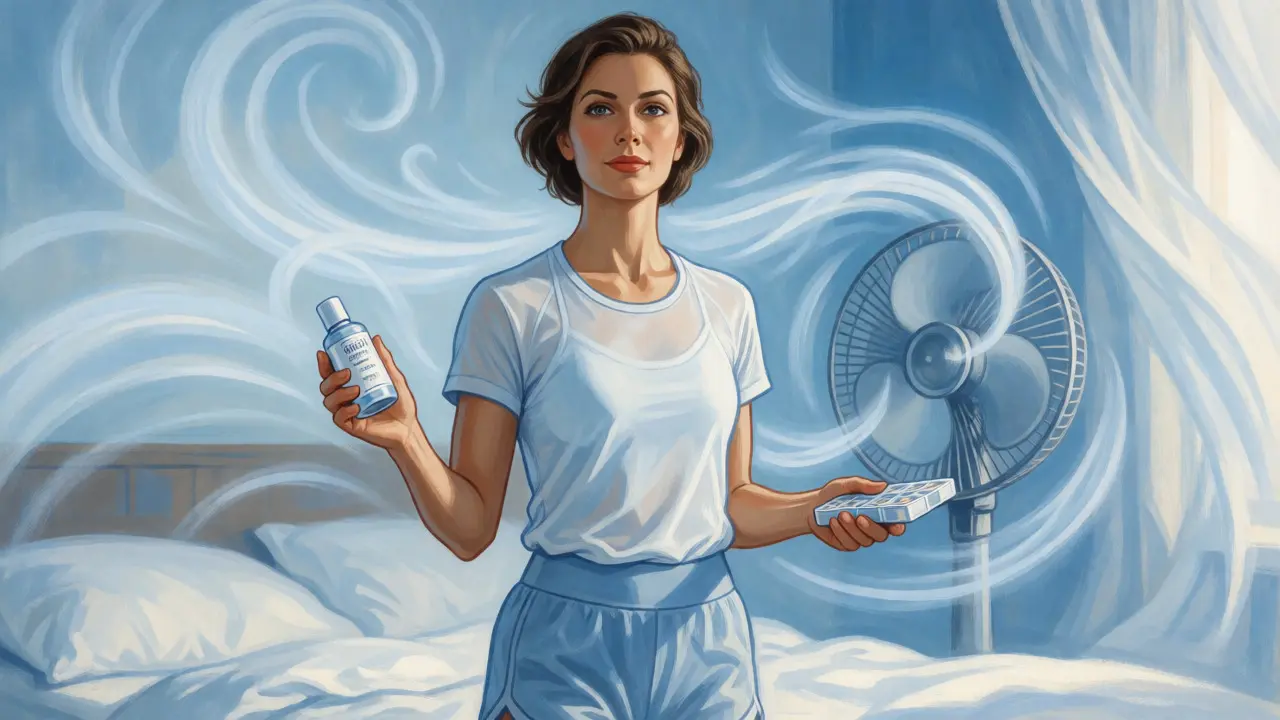
Beyond pills and creams, environmental controls matter. Keeping your bedroom cool is crucial. Aim for temperatures below 65°F (18°C). Fans, especially those with oscillating heads, can provide immediate relief during a sudden hot flash. Some patients find cooling vests helpful; these wearable devices use gel packs or water circulation to lower core body temperature. A study from UC Davis found that wearing a cooling vest for just two hours daily reduced sweat episodes by nearly 44%.
Stress management techniques like Cognitive Behavioral Therapy (CBT) also show promise. CBT doesn’t change the physiological cause of the sweating, but it changes how you react to it. Learning to stay calm during a hot flash can prevent the anxiety spiral that often makes the sensation feel worse. Six to eight sessions can lead to a 50-60% reduction in perceived symptom severity.
When to Talk to Your Doctor
Don’t suffer in silence. Nearly 30% of patients quit their meds because of sweating, which can lead to relapse or worsening health issues. Bring up this side effect early. Ask your provider: "Could this be my medication? Is there an alternative drug in the same class that doesn’t have this side effect?" Sometimes, switching from one SSRI to another resolves the issue entirely. Keep a log of when sweating occurs relative to your medication time-this data helps your doctor pinpoint the culprit.
How long does it take for medication-induced sweating to stop?
If you stop or switch the offending medication, symptoms typically resolve within a few days to a few weeks. However, if you continue the medication and manage the symptom with treatments like antiperspirants, improvement may take 7-10 days of consistent use.
Can I treat sweating without stopping my medication?
Yes. Many patients successfully manage side effects using prescription antiperspirants, dose adjustments, or adding auxiliary medications like glycopyrrolate. Stopping medication is usually a last resort due to the risk of untreated underlying conditions.
Are hot flashes different from sweating?
They are related but distinct. Hot flashes are a sudden feeling of intense heat, often accompanied by redness and palpitations, followed by sweating. Drug-induced sweating can occur without the initial heat sensation, though both result from thermoregulatory disruption.
Do all antidepressants cause sweating?
No, but it is common among SSRIs and SNRIs. Not everyone experiences it, and susceptibility varies. Some newer antidepressants or different classes like bupropion may have lower rates of sweating side effects.
Is night sweating always a sign of something serious?
Not always. While it can signal infections or other conditions, medication is a very common cause. If you started a new drug recently, it’s likely the culprit. However, persistent night sweats should always be evaluated by a doctor to rule out other causes.