Statin Muscle Symptom Checker
Select all symptoms you are currently experiencing while taking statins:
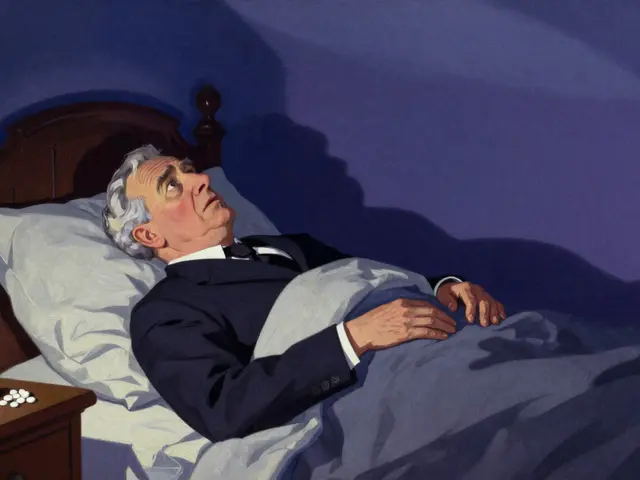
You start taking a statin is a class of medications that lower cholesterol by inhibiting the enzyme HMG-CoA reductase in the liver. to protect your heart. Instead of feeling relieved, you wake up with achy legs, weak arms, or a general sense of fatigue that wasn't there before. You aren't imagining it. Statin-induced muscle symptoms are real, common, and they range from mild annoyances to serious medical emergencies.
For decades, doctors dismissed these complaints as "nocebo" effects-pain caused by the expectation of side effects rather than the drug itself. That narrative has shifted dramatically. Recent data shows that up to 30% of people taking statins experience some form of muscle discomfort. While most cases are benign and resolve quickly, a small subset involves severe inflammation or even an autoimmune reaction that persists long after stopping the medication. Understanding the difference between simple soreness and dangerous tissue breakdown is critical for managing your cardiovascular health without sacrificing your quality of life.
The Spectrum of Statin-Induced Muscle Issues
Not all muscle pain is created equal. When discussing statin side effects, clinicians categorize them into a spectrum based on severity and biological markers. Knowing where you fall on this spectrum helps determine whether you need to stop the drug, switch brands, or seek immediate emergency care.
The most common issue is myalgia is muscle pain, tenderness, or weakness without elevated levels of creatine kinase (CK) in the blood. This affects roughly 10% to 29% of users. Your muscles hurt, but there is no actual damage to the muscle fibers detectable via standard blood tests. It’s uncomfortable, but rarely dangerous.
A step up in severity is myositis is muscle inflammation characterized by pain and significantly elevated creatine kinase (CK) levels, typically between 10 to 40 times the upper limit of normal. Here, the muscle tissue is actively inflamed. This occurs in about 0.5% of patients. The key differentiator is the CK level-a protein released when muscle cells are damaged. If your CK spikes, the injury is real.
The rarest and most dangerous form is rhabdomyolysis is severe muscle breakdown leading to the release of muscle fiber contents into the bloodstream, potentially causing acute kidney failure. This happens in fewer than 0.1% of cases. Symptoms include extreme weakness, dark urine (caused by myoglobin), and CK levels exceeding 40 times the normal limit. This is a medical emergency requiring hospitalization to prevent kidney damage.
| Condition | Prevalence | Key Symptom | CK Level Status | Action Required |
|---|---|---|---|---|
| Myalgia | 10-29% | Pain/Tenderness | Normal | Monitor or Switch Statin |
| Myositis | ~0.5% | Pain + Weakness | Elevated (10-40x ULN) | Stop Statin, Medical Review |
| Rhabdomyolysis | <0.1% | Severe Weakness + Dark Urine | Very High (>40x ULN) | Emergency Care |
Why Do Statins Hurt Muscles? The Biological Mechanism
To understand why your muscles ache, we have to look at what statins actually do inside your body. Statins work by blocking an enzyme called HMG-CoA reductase is the rate-limiting enzyme in the mevalonate pathway, responsible for producing cholesterol and other essential molecules.. While this effectively lowers LDL cholesterol, it also interrupts the production of several other vital compounds that muscle cells rely on for energy and structure.
One of the most significant collateral damages is the reduction of Coenzyme Q10 (CoQ10) is a lipid-soluble antioxidant essential for mitochondrial energy production (ATP synthesis) in cells.. Research indicates that high-dose statins can reduce muscle CoQ10 levels by up to 40%. Since mitochondria are the power plants of your cells, less CoQ10 means less ATP (energy). Without enough energy, muscle fibers become fatigued and prone to micro-tears during normal activity.
Beyond energy deficits, statins disrupt the prenylation of proteins. Prenylation is a process that anchors certain proteins to cell membranes, helping maintain structural integrity. When this process is impaired, calcium regulation within the muscle cell goes haywire. Elevated intracellular calcium activates enzymes like calpains and caspases, which essentially eat away at muscle proteins. A 2006 study showed that statins can accelerate this protein degradation pathway by 300-400%, especially when combined with physical stress like eccentric exercise.
The Hidden Danger: Immune-Mediated Necrotizing Myopathy
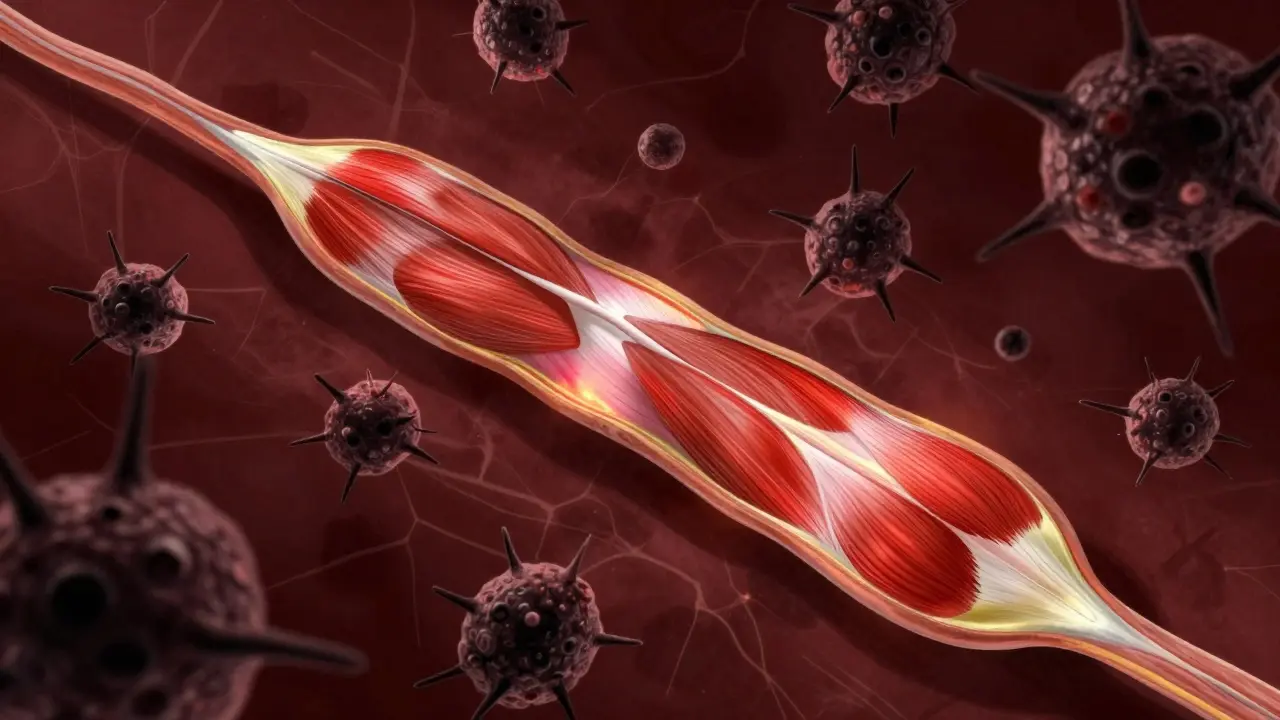
There is a rare but severe condition that defies the typical "stop the drug, get better" rule. Known as Statins-Associated Autoimmune Myopathy (SAAM) is a rare immune-mediated necrotizing myopathy triggered by statins, characterized by the presence of anti-HMGCR antibodies., or anti-HMGCR myopathy, this condition occurs in approximately 2 to 3 cases per 100,000 statin users.
In SAAM, the statin triggers the immune system to produce antibodies against the HMG-CoA reductase enzyme itself. Even after you stop taking the statin, your immune system continues to attack your muscle tissue. This leads to progressive, symmetric weakness, primarily in the shoulders and hips. Unlike typical myalgia, which resolves in weeks, SAAM symptoms persist for months or years without treatment.
Diagnosis is tricky. Many patients are initially misdiagnosed with fibromyalgia or chronic fatigue syndrome. On average, there is an 11-month delay in correct diagnosis. Key indicators include:
- Persistent proximal muscle weakness (difficulty rising from a chair or lifting arms).
- CK levels often exceeding 2,000 IU/L (normal is 30-200 IU/L).
- Muscle biopsy showing necrosis with minimal inflammation.
- Positive test for anti-HMGCR antibodies.
Treatment requires immunosuppressive therapy, such as corticosteroids, methotrexate, or IVIG, rather than just stopping the statin. Early intervention is crucial; patients treated within six months of symptom onset achieve remission in 65% of cases, compared to only 28% if treatment is delayed beyond a year.
Risk Factors: Who Is Most Vulnerable?
Not everyone experiences muscle pain, so what makes some people more susceptible? Genetics play a massive role. Variations in the SLCO1B1 gene is a gene encoding the organic anion transporting polypeptide 1B1, which regulates statin uptake into liver cells. affect how much statin enters your liver versus circulating in your bloodstream. People with certain polymorphisms, such as the rs4149056 SNP, have reduced liver uptake, leading to higher systemic exposure to the drug. This increases the risk of simvastatin-induced myopathy from 0.6% to 1.4%.
Other significant risk factors include:
- Age: Older adults (over 80) have reduced metabolic clearance and muscle mass.
- Gender: Women generally report higher rates of myalgia than men.
- Drug Interactions: Combining statins with CYP3A4 inhibitors (like amiodarone, clarithromycin, or grapefruit juice) can increase statin blood levels by 300-500%.
- Comorbidities: Hypothyroidism, vitamin D deficiency, and diabetes increase susceptibility.
- Race: African Americans face a 1.8 times higher risk of myopathy, partly due to genetic differences in statin transporters.

Managing Statin Intolerance: Practical Strategies
If you are experiencing muscle pain, do not simply ignore it, but do not panic either. Abandoning statin therapy entirely can be dangerous, as discontinuation increases the risk of cardiovascular events by 25% in high-risk patients. Instead, follow a structured approach to manage the symptoms while maintaining heart protection.
- Rule Out Other Causes: Before blaming the statin, check your thyroid function (TSH) and Vitamin D levels. Hypothyroidism and severe Vitamin D deficiency mimic statin myopathy perfectly.
- Check Drug Interactions: Review all supplements and prescriptions. If you are taking a CYP3A4 inhibitor, your doctor may need to switch you to a statin not metabolized by that pathway, such as rosuvastatin or pravastatin.
- Try "Statin Holidays": For mild myalgia, doctors often recommend stopping the statin for 2-4 weeks. If symptoms resolve completely, it confirms the statin was the culprit. Reintroduce a lower dose or a different statin.
- Switch Statins: Not all statins are equal. Lipophilic statins (simvastatin, atorvastatin) penetrate muscle tissue more easily than hydrophilic ones (rosuvastatin, pravastatin). Switching to a hydrophilic statin helps 73% of patients who were intolerant to lipophilic versions.
- Intermittent Dosing: Some patients tolerate taking their statin every other day or twice a week. This reduces cumulative muscle exposure while still providing significant LDL lowering.
What about CoQ10 supplementation? It seems logical to replace what the statin depletes. However, evidence is mixed. A 2015 Cochrane review found that only 3 out of 7 randomized trials showed significant benefit. While it won't hurt to try 200 mg/day, don't expect it to be a magic bullet for everyone.
When to Seek Immediate Help
Most statin muscle issues are manageable outpatient problems. However, you must recognize the red flags for rhabdomyolysis or severe autoimmune myopathy. Seek emergency care if you experience:
- Dark, tea-colored urine (indicating myoglobinuria).
- Sudden, severe muscle weakness preventing basic movements.
- Swelling or warmth in affected muscle groups.
- Fever accompanying muscle pain.
Early detection saves kidneys and preserves muscle function. If you suspect SAAM, ask your doctor specifically for anti-HMGCR antibody testing. Standard muscle panels will miss this diagnosis.
How long does statin muscle pain last after stopping the medication?
For typical statin myalgia, symptoms usually resolve within 1 to 2 weeks after discontinuing the drug. However, if the pain persists beyond 3 months, it may indicate a non-statins cause or a rare autoimmune condition like SAAM, which requires further investigation.
Can I take CoQ10 to prevent statin muscle pain?
While statins lower CoQ10 levels, clinical trials show inconsistent results regarding supplementation. About half of the studies suggest a modest benefit, but it is not a guaranteed cure. It is generally safe to try 200 mg daily, but discuss it with your doctor first.
Which statin is least likely to cause muscle pain?
Hydrophilic statins like rosuvastatin and pravastatin are less likely to cause muscle issues because they do not penetrate muscle tissue as readily as lipophilic statins like simvastatin or atorvastatin. Additionally, lower doses or intermittent dosing can improve tolerance.
Is statin-induced muscle damage permanent?
In most cases, no. Typical myalgia and myositis resolve fully upon stopping the drug. However, in rare cases of Statin-Associated Autoimmune Myopathy (SAAM), muscle damage can progress and require long-term immunosuppressive treatment to prevent permanent weakness.
Should I stop taking my statin if I have mild muscle soreness?
Do not stop abruptly without consulting your doctor. Mild soreness might be temporary or related to other factors like exercise or vitamin D deficiency. Your doctor may recommend a short "statin holiday" to confirm the cause before making permanent changes to your regimen.