
What Psoriasis Really Is (And Why It’s More Than Just a Skin Problem)
Psoriasis isn’t just dry, flaky skin. It’s an immune system glitch where your body attacks itself, causing skin cells to grow too fast and pile up into thick, red patches. This isn’t contagious. It’s not caused by poor hygiene. It’s a chronic, whole-body condition that affects about 125 million people worldwide. The most common type, plaque psoriasis, makes up 80-90% of cases - those raised, silvery scales on elbows, knees, and scalp. But there’s also guttate psoriasis, which hits suddenly after a strep infection, covering the body in small, drop-like spots. And then there’s the systemic side: joint pain, heart risks, diabetes, and depression. Treating psoriasis today means treating the immune system, not just the skin.
Topical Treatments: The First Line, But Not Enough for Severe Cases
If your psoriasis covers less than 5% of your skin, creams and ointments can help. Corticosteroids are the oldest tool - strong ones like clobetasol can flatten plaques fast. But long-term use can thin the skin, so they’re usually paired with calcipotriol, a vitamin D analog that slows skin cell growth. Together, they work better than either alone. Newer options like tapinarof cream (1%) are gaining traction. In clinical trials, it cleared 35% of patients’ plaques after 12 weeks with fewer side effects than steroids.
But here’s the hard truth: if your plaques are thick, widespread, or on your nails or scalp, topicals alone won’t cut it. A 2025 study showed corticosteroids alone only achieved 30-40% skin clearance. That’s why doctors don’t rely on them for moderate to severe cases. For stubborn scalp psoriasis, a foam combo of calcipotriol and betamethasone works in 89% of patients. For nails, a shot of triamcinolone directly into the nail bed improves pitting in 75% of cases after 12 weeks. Topicals need patience - applying them correctly takes practice. Many patients give up too soon because they don’t see results in a week. It often takes 4-6 weeks to notice real change.
Oral Systemic Drugs: The Middle Ground Between Creams and Injections
When topicals fail and biologics feel too intense, oral meds step in. Methotrexate has been used for decades - taken once a week, it slows skin turnover and reduces inflammation. About half to 60% of users get 75% skin clearance by week 16. But it can affect the liver and blood cells, so regular blood tests are required. Cyclosporine works faster - 60-70% clearance in 12 weeks - but it’s not for long-term use because of kidney risks. Acitretin, a vitamin A derivative, helps with scaling and is often used for pustular or palmoplantar psoriasis, but it’s not safe during pregnancy and can dry out your lips and eyes.
Newer oral drugs are changing the game. Apremilast (Otezla) is a pill taken twice daily that blocks a specific enzyme involved in inflammation. It clears 33% of patients’ skin by week 16. It doesn’t need blood monitoring, and side effects are mostly mild - nausea or diarrhea in the first few weeks. But the big surprise? Deucravacitinib. This once-daily pill targets a different pathway (TYK2) and cleared nearly 59% of patients’ skin at 16 weeks. That’s close to some biologics, without injections. It’s now approved in the U.S. and EU, and many dermatologists are starting to prescribe it as a first oral option.

Biologics: The Game-Changers for Moderate to Severe Psoriasis
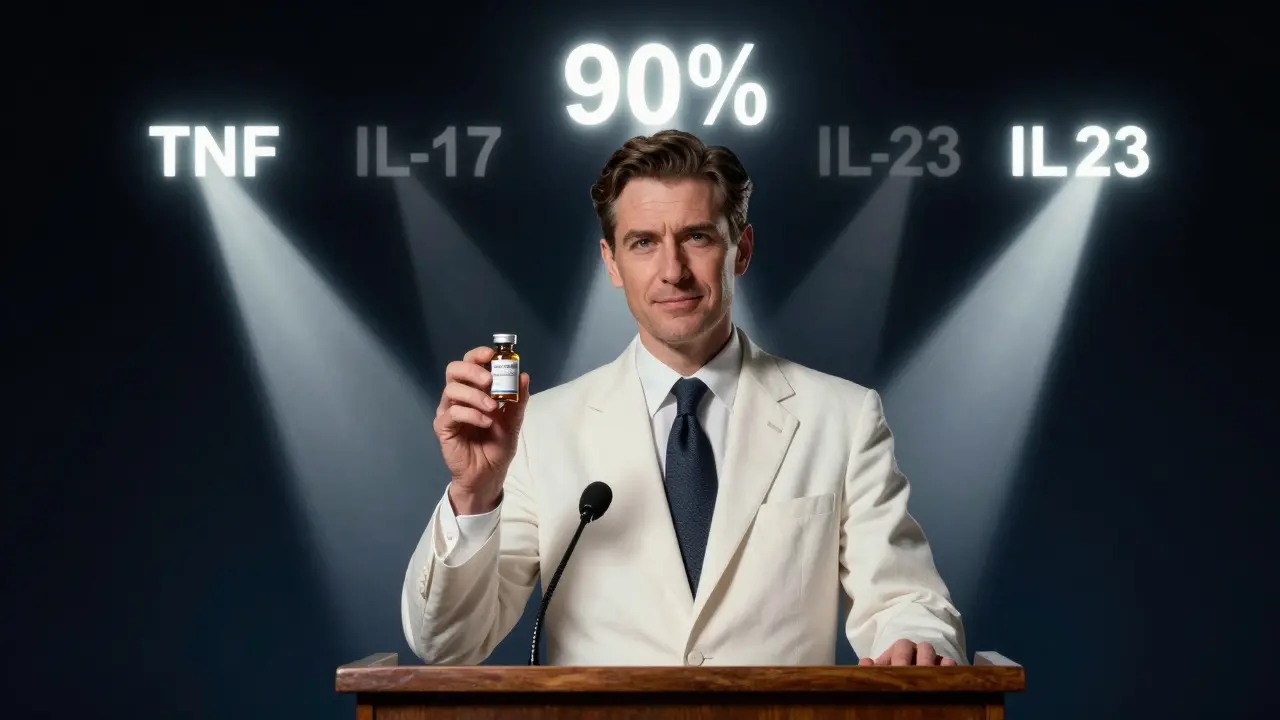
Biologics are targeted drugs made from living cells. They don’t suppress your whole immune system - they hit specific troublemakers. There are three main families: TNF inhibitors, IL-17 inhibitors, and IL-23 inhibitors. Each works differently, and each has different results.
TNF blockers like adalimumab (Humira) were the first biologics approved for psoriasis. They clear about 78% of patients’ skin by week 16. But they’re older, require weekly or biweekly shots, and carry a higher risk of reactivating old infections like tuberculosis.
IL-17 inhibitors like secukinumab (Cosentyx) work faster. Many patients see improvement in as little as two weeks. They clear 79% of skin to 90% or better at 16 weeks. But they’re not ideal if you have Crohn’s disease - they can make it worse.
IL-23 inhibitors - guselkumab (Tremfya), risankizumab (Skyrizi), and tildrakizumab (Ilumya) - are now the gold standard. They target the root of the problem, upstream of IL-17. In trials, 84-90% of patients hit 90% skin clearance. They’re dosed every 8 to 12 weeks, sometimes even every 3 months. That’s a huge win for adherence. A 2025 real-world study of over 31,000 patients found risankizumab had the highest retention rate - 78% of users stayed on it after a year. Guselkumab also shines for scalp and nail psoriasis, clearing 74% of scalp lesions compared to 62% with older biologics.
Choosing the Right Treatment: It’s Not One-Size-Fits-All
There’s no universal best drug. Your choice depends on your psoriasis type, how much skin is affected, your other health conditions, and your lifestyle. If you have psoriatic arthritis, TNF inhibitors or IL-17 blockers might be preferred. If you have inflammatory bowel disease, avoid IL-17 inhibitors - go for IL-23 instead. If you hate needles, oral drugs like deucravacitinib or apremilast might be better. If you want the deepest clearance and the least frequent shots, IL-23 inhibitors lead the pack.
Cost is another factor. Biologics cost $28,000-$34,000 a year. But 85% of insured patients pay $0-$150 monthly thanks to manufacturer assistance programs. Many drugmakers offer free starter kits, co-pay cards, and even home nursing for injections. Insurance often requires trying cheaper options first - methotrexate, then apremilast - before approving biologics. That’s changing, though. More dermatologists now start biologics directly if your PASI score is over 10 or your quality of life is badly affected (DLQI >10).
What’s Coming Next: Oral Peptides, Faster Results, and Maybe a Cure
The future of psoriasis treatment is moving away from needles. Oral peptides - pills that act like biologics - are in late-stage trials. One called a selective IL-23 receptor antagonist cleared 82% of patients’ skin in phase 3 studies. That’s biologic-level results, taken as a pill. If approved, it could be available by 2027.
Another exciting development: stopping treatment after early success. The GUIDE trial is testing whether patients who get 100% clearance on guselkumab can stop injections and stay clear for years. Early data suggests it’s possible - about 30% of patients stayed clear for over a year after stopping. That’s not a cure, but it’s close. It means psoriasis might become a condition you manage, not live with forever.
For guttate psoriasis, which often clears on its own after a strep infection, treatment is usually supportive - moisturizers, mild steroids, and sometimes light therapy. But if it turns chronic, the same systemic options apply. And for pustular psoriasis, a new drug called spesolimab can clear pustules in days, not weeks.
Real Patient Experiences: What Works and What Doesn’t
On Reddit and patient forums, the same patterns keep showing up. People who switched from adalimumab to guselkumab often say: "I was on Humira for two years and only got 50% better. Guselkumab cleared 95% in three months. And I only inject every three months. It’s life-changing." Others say: "I tried secukinumab, but it took four months to work. I couldn’t wait that long before my wedding." Speed matters.
Cost still stings. One user wrote: "Even with insurance, guselkumab costs me $500 a month. That’s half my rent." But most manufacturers offer $0 co-pays for qualifying patients. If you’re struggling, ask your dermatologist about patient assistance programs - they’re more common than you think.
Side effects are usually mild: injection site redness, headache, or upper respiratory infections. Serious infections are rare, but you need to watch for fever, chills, or unexplained fatigue. Never skip a TB test before starting biologics.
What to Do Next: A Simple Action Plan
- Calculate your PASI score (how much skin is covered and how red/thick the plaques are). Your dermatologist can help.
- Assess your quality of life. Are you avoiding social events? Feeling depressed? If yes, systemic treatment is likely needed.
- Check for comorbidities. Do you have joint pain? High blood pressure? High cholesterol? These change your drug options.
- Ask your doctor: "What’s my endotype?" Some patients don’t respond to IL-17 blockers because their psoriasis is driven by interferon, not Th17. Testing exists.
- Explore oral options first if you hate needles. Deucravacitinib is now a solid choice.
- If you’re a candidate for biologics, ask about IL-23 inhibitors - they’re the most effective and convenient now.
- Don’t wait. Early treatment reduces joint damage and heart risk.
Support and Resources You Can Use Right Now
You don’t have to figure this out alone. The National Psoriasis Foundation offers a free Biologics Navigator tool that walks you through drug options, side effects, and insurance steps. Their patient support line answers questions about co-pays and financial aid. Many drugmakers have 24/7 nurse hotlines that help with injection training and side effect management. Telehealth services like Dermatology Telehealth Network can connect you with a specialist in under 48 hours, even if you’re in a rural area. And if you’re feeling overwhelmed, online communities like r/psoriasis have over 12,500 members sharing real tips - from using humidifiers in winter to applying steroid creams under plastic wrap for stubborn plaques.




Kristen Russell
January 2 2026I switched to guselkumab last year and it’s been a game changer. No more hiding my elbows. And the injections? Every three months. I forget I’m even on treatment.
Life’s too short for weekly shots.