
You've probably stood at the pharmacy counter and had the pharmacist ask if you're okay with the generic version of your prescription. For some, it's a quick way to save a few dollars. For others, it sparks a nagging doubt: is this just a cheap "copy"? There is a common worry that generics are watered-down versions of the original drug or that they don't work as well because they aren't the "real thing." The truth is that while generics are technically copies, they aren't "knock-offs." They are scientifically validated equivalents that must meet strict government standards to ensure you get the same medical result.
The Truth About "Copies" in Medicine
When people hear the word "copy," they often think of a low-quality imitation. In pharmacy, however, a copy is called a generic drug is a medication created to be identical to a brand-name drug in dosage, safety, strength, route of administration, quality, purity, and efficacy . To get approved, a manufacturer doesn't just mimic the look of a pill; they must prove bioequivalence. This means the drug delivers the same amount of active ingredient into your bloodstream in the same amount of time as the original.
The regulatory backbone for this process is the Hatch-Waxman Act, a 1984 law that allowed generic makers to use an Abbreviated New Drug Application (ANDA). Instead of spending a decade and millions of dollars repeating the original clinical trials, they only need to prove that their version performs the same way in the body. According to the FDA, generics work the same way and provide the same benefits as the brand-name versions.
Why They Look Different (and Why That's Okay)
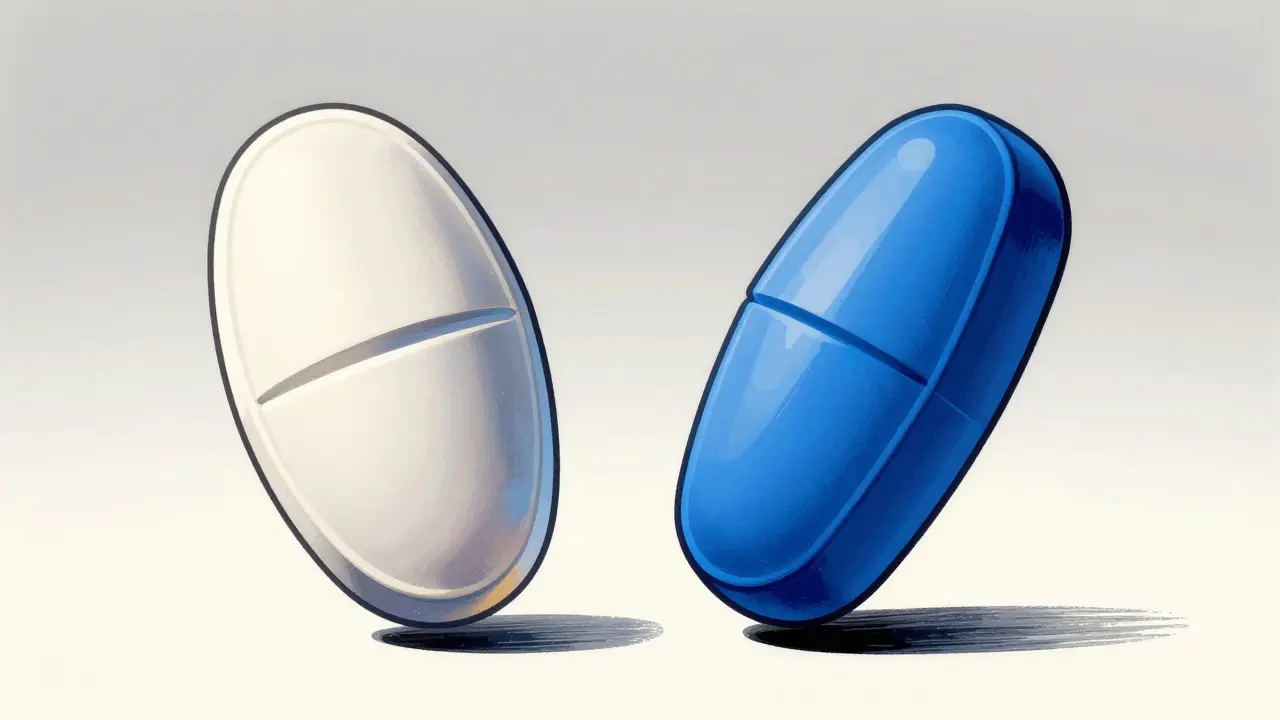
If they are identical, why is the generic pill blue while the brand name is white? This comes down to trademark laws. Brand-name companies own the specific look, shape, and color of their tablets. Generic manufacturers are actually required to make their products look different so they aren't confused with the original.
The real difference lies in the excipients, which are the inactive ingredients like fillers, binders, colors, and preservatives. While the active pharmaceutical ingredient (API) is exactly the same, these inactive parts can vary. For 96% of people, this makes zero difference in how the drug works. However, a small number of people might be sensitive to a specific dye or filler in a generic version, which can sometimes be mistaken for the drug itself not working.
| Feature | Brand-Name Drug | Generic Drug |
|---|---|---|
| Active Ingredient | Original Molecule | Identical Molecule |
| Inactive Ingredients | Proprietary Blend | Varies by Manufacturer |
| FDA Approval Process | Full New Drug Application | ANDA (Bioequivalence proof) |
| Appearance | Trademarked Look | Must be visually distinct |
| Average Cost | Higher (Premium) | Significantly Lower (85% less on average) |
The Math Behind the Medicine
The FDA doesn't just take a company's word that a drug is equivalent. They use rigorous pharmacokinetic studies. Specifically, they look at the "Area Under the Curve" (AUC) and the maximum concentration (Cmax) of the drug in the blood. For a generic to pass, the 90% confidence interval of these measurements must fall within 80-125% of the brand-name drug. In reality, FDA testing shows that most generics have an average active ingredient concentration of about 99.2%.
This precision is why generic substitution is so widespread. In the U.S., generic drugs now make up about 90% of all prescriptions filled. For common chronic medications like statins (for cholesterol) or ACE inhibitors (for blood pressure), the substitution rate is nearly universal-often over 98%-because the therapeutic outcome is identical.
When "Close Enough" Isn't Enough: The NTI Exception
While generics are safe for most, there is a small group of medications where you have to be more careful. These are called Narrow Therapeutic Index (NTI) drugs. In these cases, the gap between a dose that works and a dose that is toxic (or fails) is very thin. Even a tiny variation in how a generic is absorbed can lead to a problem.
Common examples of NTI drugs include:
- Warfarin: A blood thinner where too much can cause bleeding and too little can cause clots.
- Levothyroxine: A thyroid medication where small shifts can throw off your hormone levels.
- Phenytoin: An antiepileptic drug where consistency is key to preventing seizures.
For these specific meds, doctors may specify "Dispense as Written" (DAW), meaning they want you to stay on one specific brand to avoid the slight variations that happen when switching between different generic manufacturers.
The Financial Impact of Switching
The primary reason generics exist is to break the monopoly of patents. A pharmaceutical company typically holds a patent for 20 years. Once that expires, other companies can enter the market. This competition crashes the price. Data from GoodRx shows that while a brand-name drug might cost around $61, its generic equivalent often drops to about $4.27.
This isn't just about saving pocket change; it's about health outcomes. When drugs are too expensive, people simply stop taking them. Research from Harvard Medical School indicates that cost-related non-adherence affects 25% of patients on brand-name drugs, but only 8% of those on generics. By making medicine affordable, generics actually save lives by ensuring patients actually take their pills.

Common Misconceptions and Patient Experiences
Despite the data, many people still feel that generics are inferior. You'll find threads on Reddit or patient forums where people claim a generic "just didn't work' like the original. Often, this is a placebo effect or a reaction to a different inactive ingredient (like a filler that causes mild indigestion).
Interestingly, a survey from the Kaiser Family Foundation found that 89% of insured adults who used generics were satisfied with them. Even in complex areas like epilepsy, where some patients report breakthrough seizures after switching, subsequent FDA analysis usually finds that the cause was related to other health factors rather than a failure of the drug's bioequivalence.
Do generic drugs take longer to work than brand-name drugs?
No. Because they must be bioequivalent, the rate at which the active ingredient is absorbed into your bloodstream must be nearly identical to the brand-name version. You should feel the effects in the same timeframe.
Can I switch from a brand-name drug to a generic at any time?
For most medications, yes. However, if you are taking an NTI drug (like certain thyroid or blood-thinning meds), you should consult your doctor first, as they may want to monitor your blood levels more closely during the transition.
Why does my generic drug look different every few months?
Your pharmacy may switch generic suppliers based on cost or availability. Since different manufacturers use different dyes and fillers, the pill's color or shape might change, even though the active medicine remains the same.
Are "biosimilars" the same as generic drugs?
Not exactly. Traditional generics are simple chemical copies. Biosimilars are made from living organisms (biologics) and are much more complex. They are "highly similar" but not identical copies because of the way biological molecules are structured.
Are generic drugs less regulated than brand-name ones?
No. Generic manufacturers must follow the same Current Good Manufacturing Practice (CGMP) regulations as brand-name companies. The FDA inspects the facilities to ensure purity, quality, and strength are maintained.
Next Steps for Patients
If you are unsure about a generic substitution, start by asking your pharmacist to check the FDA Orange Book. This is the official registry that lists which generics have been approved as therapeutically equivalent to their brand counterparts.
If you have a history of allergies to specific dyes or fillers, tell your pharmacist. They can often look up the inactive ingredients of different generic brands to find one that doesn't contain your allergen. Finally, if you are taking a high-risk medication for a condition like epilepsy or severe heart disease, ask your doctor if your specific drug is considered NTI before making the switch.





Mary Johnson
April 13 2026Sure, the FDA says it's fine, but who actually funds the FDA? It's all big pharma playing a game of musical chairs with our health. They tell you it's bioequivalent just so they can swap out high-quality ingredients for cheap fillers from overseas factories that probably don't even have running water. I've felt the difference myself, and it's terrifying how they just dismiss patient experiences as a 'placebo effect' when we're the ones actually taking the pills!