
When you leave the hospital, you’re expected to manage a new set of medications-some changed, some stopped, some added. But here’s the problem: medication reconciliation often fails at discharge, and that’s where dangerous drug interactions start.
Studies show that nearly half of all patients don’t fully understand their meds after leaving the hospital. For those on five or more drugs, the risk of a harmful interaction spikes. One wrong dose, a missed pill, or a forgotten supplement can land you back in the ER. This isn’t rare. It’s systemic. And it’s preventable-if you know how to do it right.
What Medication Reconciliation Actually Means
Medication reconciliation isn’t just a checklist. It’s the process of comparing every medication you were taking before you went to the hospital with the ones you’re being sent home with. This includes prescriptions, over-the-counter drugs, vitamins, herbs, and even supplements like fish oil or melatonin.
The goal? Catch mismatches. Did they stop your blood pressure pill but forget to restart it? Did they add a new painkiller that clashes with your blood thinner? Did they change the dose of your diabetes med without telling you? These aren’t hypotheticals. In a 2020 study, 42.7% of discharge lists missed medications patients were taking at home. Another 24.6% added drugs that shouldn’t have been there.
The Joint Commission made this a national safety goal back in 2006. Hospitals are required to do it. But compliance? Only 65% of hospitals do it well at discharge. That’s not good enough.
Why Discharge Medication Lists Are So Often Wrong
The biggest source of errors? The patient’s own memory.
When you’re admitted, nurses ask, “What meds do you take?” You say, “I take my blood pressure pill, my sugar pill, and that green one for my knee.” But you don’t mention the aspirin you take daily. Or the turmeric capsule your cousin swore by. Or the half-dose of your old antidepressant you stopped six months ago but still keep in the cabinet.
That’s why patient self-reports have a 42.1% error rate. Meanwhile, the hospital’s discharge summary-the official list your doctor signs off on-is only 17.3% wrong. That’s why you need to treat the discharge list as the starting point, not your memory.
Another big problem: meds held during hospitalization get forgotten. If you were taken off your statin before surgery, did someone restart it? If you were on warfarin and it was paused for a procedure, was it restarted? One Reddit user shared how his father was discharged without warfarin after a surgery. Two weeks later, he had a pulmonary embolism. He was readmitted. It was preventable.
Step-by-Step: How to Reconcile Your Meds Before Leaving the Hospital
You can’t rely on the hospital staff to catch everything. You need to take control. Here’s how:
- Bring a full list before admission. Write down every pill, patch, inhaler, liquid, and supplement you take-even if you skip doses. Include brand and generic names, doses, and how often you take them. Keep this list in your phone and wallet.
- Ask for a copy of your discharge medication list. Don’t wait for it to be handed to you. Ask your nurse or pharmacist: “Can I get a printed copy of my final discharge meds?”
- Compare it to your pre-hospital list. Use your own list. Highlight every change: added, removed, changed dose, changed frequency. If something’s missing, ask why. “Why was my metoprolol taken off? Is it safe to stop?”
- Ask about interactions. Say: “Could any of these new meds interact with what I was already taking?” Especially if you’re on blood thinners, diabetes meds, or heart drugs. These are the highest-risk combinations.
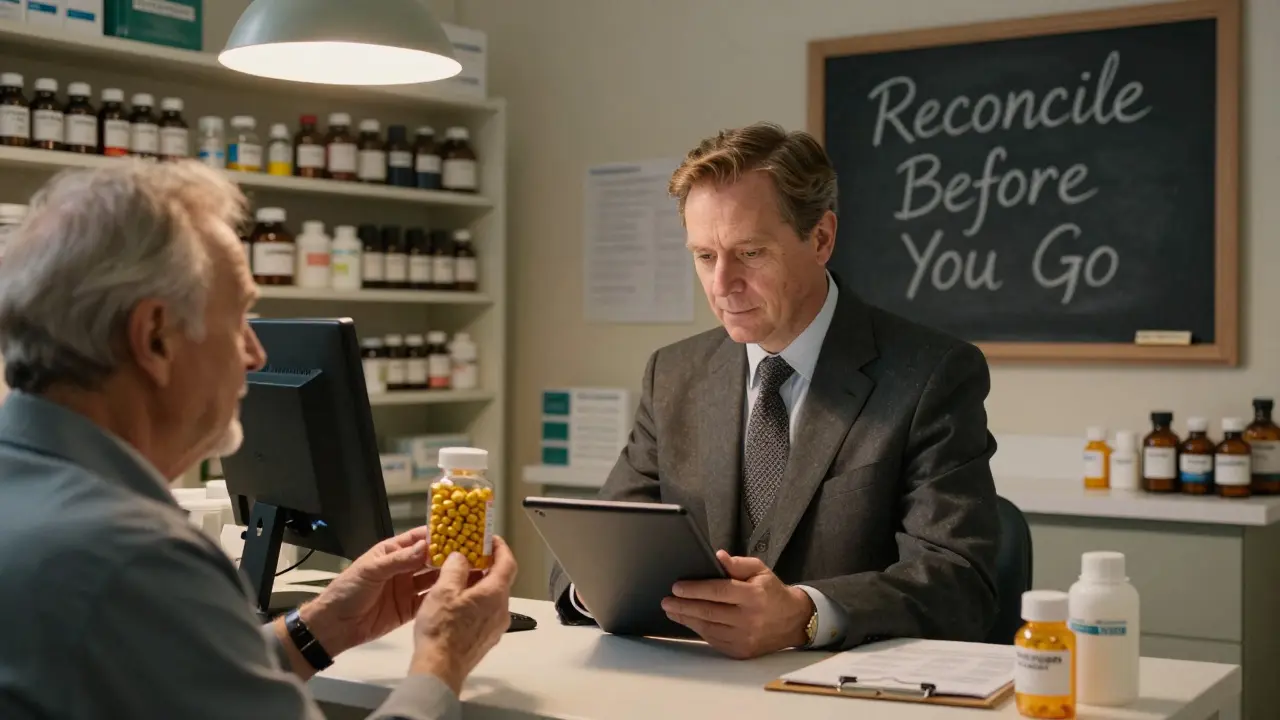
- Verify with the pharmacist. Ask if the hospital has a discharge pharmacist. If they do, insist on a 10-minute chat. Pharmacists catch 92% of discrepancies in studies. They’re trained to spot interactions you won’t.
- Confirm refill instructions. “Will my new prescriptions be ready at my pharmacy? Do I need to call in the old ones?” Don’t assume. Many patients get home and realize their new med isn’t covered by insurance-or they can’t get it until next week.

Red Flags That Mean Your Reconciliation Failed
These signs mean you’re at risk:
- You’re told to stop a chronic med (like a statin or beta-blocker) with no explanation.
- You’re given a new drug without knowing what it’s for.
- You’re told to take something “as needed,” but no clear instructions are given.
- Your discharge summary doesn’t match what your doctor told you.
- You’re discharged without a follow-up appointment scheduled within 7 days.
One of the most dangerous scenarios: a patient on multiple meds gets discharged with a new antibiotic that interacts with their blood thinner. The result? A bleeding event. The CDC says 1 in 5 hospitalizations for older adults is due to a drug interaction. Most happen right after discharge.
What to Do After You Get Home
Reconciliation doesn’t end at the hospital door.
Within 24 hours of getting home:
- Organize your meds in a pillbox labeled by time of day.
- Call your primary care doctor or pharmacist and read them your discharge list. Ask: “Does this match what you expect?”
- Check your insurance formulary. Are your new meds covered? If not, ask your doctor for alternatives.
- Set phone reminders for each dose. Missing one dose of a blood thinner or diuretic can cause serious problems.
- Keep your old medication bottles for 30 days. If you have side effects, you’ll know exactly what you took.
And don’t wait for your follow-up visit. If you feel off-dizzy, confused, bruising easily, or having trouble breathing-call your doctor today. Don’t wait a week.
The Hidden Risk: Supplements and OTC Drugs
Most patients forget about the “non-prescription” stuff. But these are often the culprits in interactions.
St. John’s Wort can make your antidepressant or birth control useless. Garlic and ginkgo can thin your blood like aspirin. Calcium supplements can block your thyroid med. Even vitamin K can undo warfarin’s effects.
Ask yourself: “Would I tell my doctor I take this?” If the answer is no, you’re not being honest with yourself. And that’s where the risk hides.
What Hospitals Should Be Doing (But Often Aren’t)
Good hospitals have a pharmacist meet with you before discharge. They use electronic records to flag interactions. They send your updated med list to your primary care doctor within 24 hours.
But here’s the reality: most hospitals only have 7.3 minutes per patient to do this. The recommended time? 15 to 20 minutes. That’s why so many slips through.
Some hospitals are using AI tools to scan discharge summaries for missing meds. Mayo Clinic’s system catches 94% of omissions. But even AI can’t ask you if you took your evening aspirin last week.
Technology helps. But human verification-when you sit down and say, “This is what I actually take”-is still the gold standard.
Who’s Responsible When Something Goes Wrong?
You are.
Yes, hospitals should do better. Yes, doctors and pharmacists should communicate. But at the end of the day, you’re the one managing your meds. If you don’t double-check, no one else will.
And if you’re over 65, on five or more drugs, or have heart, kidney, or liver disease-you’re in the highest-risk group. That means you need to be extra vigilant.
Final Checklist: Your Discharge Med Safety Plan
Before you leave the hospital, make sure you’ve done this:
- Got a printed copy of your discharge meds list.
- Compared it to your own pre-hospital list.
- Asked why each change was made.
- Confirmed with a pharmacist.
- Asked about interactions with supplements or OTC drugs.
- Know what each pill is for and when to take it.
- Scheduled a follow-up with your doctor within 7 days.
- Called your pharmacy to ensure all prescriptions are ready.
If you did all of that, you’ve done more than 80% of patients. And you’ve just slashed your risk of a dangerous interaction.
What if I don’t remember all the meds I was taking before the hospital?
Start by checking your pharmacy’s online portal. Most let you download your full prescription history. If you use a pill organizer, look at the labels. Call your primary care doctor’s office-they often have your active med list on file. If all else fails, bring in every bottle you have at home, even empty ones. The pharmacist can help identify them.
Can I just rely on my doctor to fix this at my follow-up?
No. By the time you see your doctor, you may have already taken the wrong dose of a new med or mixed it with something dangerous. Reconciliation needs to happen at discharge-not days later. Your follow-up is for review, not first-time verification.
Why do hospitals skip medication reconciliation at discharge?
Time and staffing. Most hospitals have only 7 minutes per patient to complete discharge paperwork, but reconciliation takes 15-20 minutes. Nurses are often stretched thin, and pharmacists aren’t always available. It’s not negligence-it’s systemic under-resourcing. That’s why you need to take charge.
What’s the most common dangerous interaction after discharge?
The biggest risk is combining a new NSAID (like ibuprofen or naproxen) with a blood thinner like warfarin or apixaban. This increases bleeding risk. Another common one is adding a new antibiotic (like clarithromycin) to a statin-this can cause severe muscle damage. Always ask: “Is this new drug safe with my other meds?”
How do I know if a new medication is causing side effects?
Watch for sudden changes: unusual bruising, dizziness, confusion, swelling in your legs, or feeling unusually tired. If you start a new med and feel worse within 2-3 days, contact your doctor immediately. Don’t wait. Many interactions show up fast.
Are there tools or apps that help with medication reconciliation?
Yes. Apps like MyTherapy, Medisafe, and MyChart (if your hospital uses it) let you log your meds, set reminders, and share lists with providers. Some pharmacies offer free med sync services where they consolidate all your prescriptions into one refill schedule. Use them.




Teresa Marzo Lostalé
December 29 2025Been there. My grandma got discharged with a new blood thinner but no one told her to stop the fish oil. Two weeks later, she was in the ER with a bruise the size of a grapefruit. We didn’t know it was the combo until the pharmacist pulled up her meds. Hospitals aren’t evil-they’re just drowning.