
When teaching patients about their condition - whether it’s diabetes, heart disease, or managing medications - the goal isn’t just to give them information. It’s to make sure they understand it well enough to act on it. But how do you know if they really get it? Many clinics hand out brochures, run through a checklist, and assume everything’s fine. That’s not enough. Tracking generic understanding - the ability to apply knowledge across different situations - is what separates effective patient education from empty compliance.
Why generic understanding matters more than memorization
Patients don’t need to recite the side effects of their pills. They need to know what to do when they feel dizzy, how to adjust their diet when dining out, or when to call their doctor. That’s generic understanding: taking what they learned and using it in real life, even when the situation isn’t exactly the same as the one they were taught.
Think of it this way: if you teach someone to recognize a high blood sugar reading on a glucose monitor, but they can’t tell when their symptoms match that reading without the device, they’re not truly understanding. They’re just following instructions. Real understanding means they can connect the dots between how they feel, what their body is doing, and what action to take - even without a manual.
Studies show that patients who demonstrate generic understanding have 40% fewer emergency visits and 35% better medication adherence than those who only memorize facts (NIH, 2012). This isn’t about intelligence. It’s about how well the education was designed to build transferable skills.
Direct vs. indirect assessment: what actually works
There are two main ways to measure understanding: direct and indirect.
Direct assessment means watching or testing what the patient actually does. Examples:
- Asking them to demonstrate how they’d use their inhaler in front of you
- Having them explain, in their own words, why they take their medication at a certain time
- Role-playing a scenario: “What would you do if you missed a dose and your pharmacy is closed?”
These methods give you real evidence. No guesswork. You see if they can do it - not just if they say they can.
Indirect assessment relies on what patients say about themselves:
- Surveys: “Do you feel confident managing your condition?”
- Feedback forms: “Was this education helpful?”
- Follow-up calls: “Did you find the materials useful?”
These are easy to collect - but they’re unreliable. A 2023 survey of 142 healthcare providers found that 68% of patients who said they “understood everything” couldn’t correctly explain their treatment plan when asked directly. Self-reported confidence doesn’t equal real understanding.
Formative assessment: the secret weapon in patient education
Most clinics wait until the end of a session to check understanding. That’s too late. By then, confusion has set in, and the patient has already left.
Formative assessment means checking in while you’re teaching. It’s quick, low-stakes, and gives you real-time feedback. Here’s what works:
- Teach-back method: “Can you tell me how you’ll take this medicine?” Then listen - don’t correct immediately. Let them explain. If they miss something, say: “I see you got part of it. Let’s go over the part about timing.”
- One-minute summaries: After explaining a concept, ask: “What’s the one thing you’ll remember tomorrow?”
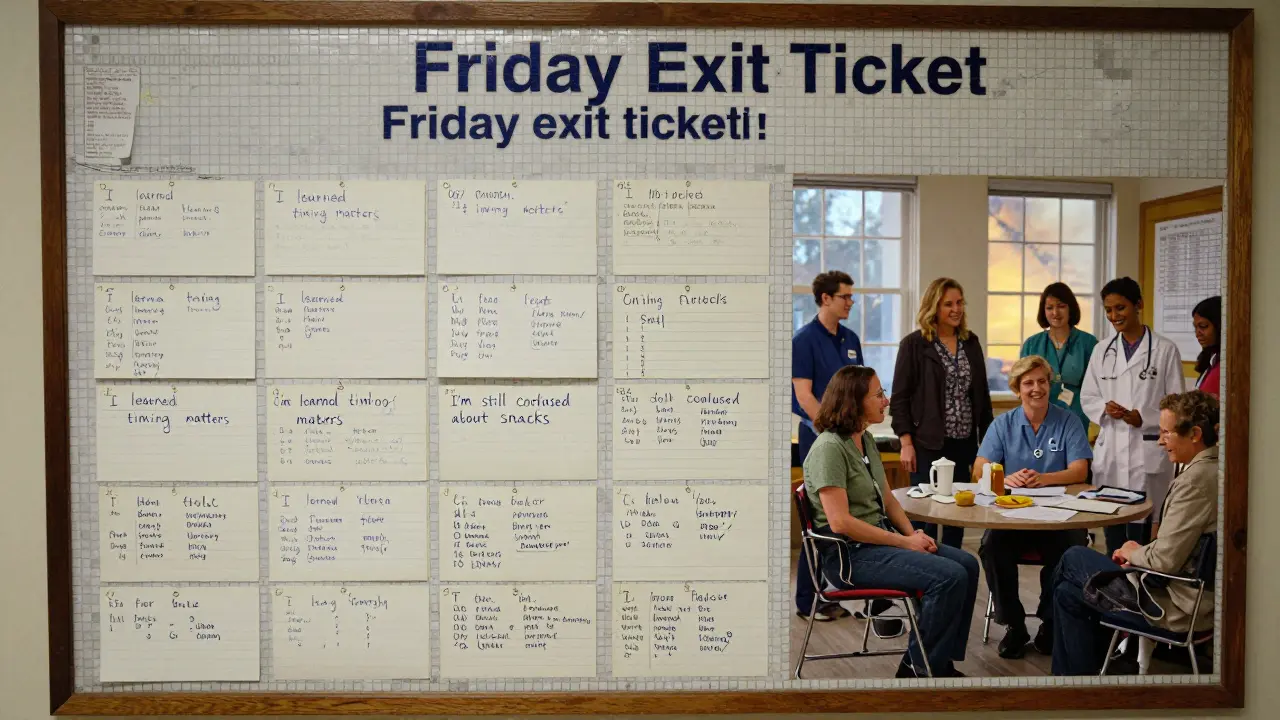
- Exit tickets: Give them a slip of paper with two questions: “What’s one thing you learned?” and “What’s still confusing?” Collect before they leave.
One community clinic in Bristol started using exit tickets after every diabetes education session. Within six months, their rate of patients correctly managing insulin doses jumped from 52% to 81%. Why? Because they caught misunderstandings early - like a patient who thought “twice daily” meant “after breakfast and after dinner,” not “every 12 hours.”

Using rubrics to measure understanding - not just compliance
Many providers use checklists: “Did the patient take the pill? Did they get the pamphlet? Did they sign the form?” That’s not assessment. That’s paperwork.
A rubric breaks down understanding into clear levels. For example, here’s a simple rubric for assessing medication understanding:
| Level | What the patient can do | What it shows |
|---|---|---|
| Basic | Can repeat the name of the drug | Memorized, not understood |
| Intermediate | Can explain why they take it and when | Understands purpose and timing |
| Advanced | Can describe what happens if they miss a dose, and what to do about it | Applies knowledge to real-life situations |
Using this rubric, staff don’t just say “they got it.” They know exactly where the patient stands - and what to fix next. A 2023 LinkedIn survey of 142 healthcare educators found that 78% said rubrics improved both patient outcomes and teaching efficiency.
Why traditional tests fail in patient education
Some clinics give patients a quiz after a session. “Which of these is a side effect of Metformin?” That’s a norm-referenced test - it compares them to others. But patients aren’t competing. They’re learning.
What you need is a criterion-referenced approach: Did they reach the standard? Not “Did they score above average?”
For example, the standard might be: “Patient can identify two signs of low blood sugar and describe one action to take.” If they can’t, you don’t move on. You re-teach. This is how hospitals like the Mayo Clinic and NHS clinics are now training staff.
Traditional tests also ignore context. A patient might ace a written quiz but panic when they see their glucose reading is 280. Why? Because they don’t know what “high” means in real life. That’s why real-world simulations matter more than paper exams.
What’s changing in patient education - and what’s next
More institutions are moving away from one-time education sessions. They’re building ongoing learning into care:
- Text message check-ins: “How are you feeling today?” with a follow-up option to connect with a nurse
- App-based progress tracking: Patients log symptoms, and the system flags patterns
- Peer-led groups: Patients teach each other using real-life stories
According to the HolonIQ 2023 Global Education Technology Report, tools that track understanding over time - not just one-time scores - are growing 68% faster than traditional methods. Why? Because understanding isn’t a one-time event. It’s a journey.
Looking ahead, AI tools are starting to help. Some platforms now analyze patient voice responses during check-ins to detect confusion - like repeated questions or vague answers - and alert providers to re-engage. This isn’t science fiction. It’s already being piloted in NHS clinics.
Three steps to start tracking generic understanding today
You don’t need a fancy system. You don’t need to overhaul your whole program. Here’s how to begin:
- Replace one survey with a teach-back question. After explaining anything - medication, diet, activity - ask: “Can you tell me how you’ll do this at home?” Listen. Don’t interrupt.
- Use a simple 3-level rubric. Start with one key skill: medication adherence, symptom recognition, or appointment prep. Rate patients as Basic, Intermediate, or Advanced. Track progress over time.
- Collect exit tickets weekly. Two questions: “What’s one thing you learned?” and “What’s still unclear?” Review them every Friday. Adjust your next week’s teaching based on what you find.
These small changes cut re-teaching time by half and improve patient confidence in under a month. You’re not just teaching. You’re making sure they understand - deeply and for life.



David L. Thomas
March 10 2026Generic understanding is the real deal. I've seen so many patients nod along during education sessions, then show up in the ER with a glucose meter they don't know how to use. It's not about memorizing facts-it's about building mental models. When someone can explain why they're taking a pill in their own words, or adjust their diet after a family dinner, that's transferable learning. That's cognitive flexibility in action.
And yeah, teach-back works. Not because it's trendy, but because it forces the brain to reconstruct knowledge, not just recall it. The brain doesn't store information like a hard drive. It builds networks. If you can't connect the dots between symptoms, meds, and actions, you're just following instructions. And that's a recipe for failure.