That sudden, sharp tug in your neck when you turn your head too quickly? Or the dull, persistent ache that settles in after a long day at the desk? You are likely dealing with cervical strain, a common injury involving the stretching or tearing of muscles, tendons, and ligaments in your cervical spine. It is not just an annoyance; it is a significant medical issue affecting millions. In fact, cervical strain accounts for roughly 60-70% of all acute neck pain cases seen by primary care doctors. While most people recover fully within weeks, ignoring the signs can lead to chronic pain that lasts months or even years.
Understanding what is happening inside your neck is the first step to fixing it. This guide breaks down exactly what cervical strain is, how to tell it apart from more serious conditions like pinched nerves, and the specific, evidence-based steps you need to take to heal faster. We will look at why some treatments work better than others and how you can prevent this from becoming a permanent part of your life.
What Is Cervical Strain and What Does It Feel Like?
Cervical strain is essentially a soft tissue injury. Think of the muscles and connective tissues in your neck like rubber bands. When you stretch them beyond their normal limit-whether through a sudden jerk, poor posture over time, or heavy lifting-they develop micro-tears. These tears trigger inflammation, which causes pain and stiffness as your body attempts to protect the area.
The symptoms are usually quite distinct. If you have a cervical strain, you will likely experience:
- Localized pain: The pain stays in your neck and upper shoulders. It does not shoot down your arms.
- Stiffness: Turning your head feels difficult or restricted. About 87% of patients report significant stiffness.
- Tenderness: Pressing on certain spots in your neck triggers sharp pain.
- Movement-related worsening: The pain gets worse when you move your neck and improves when you rest.
The severity depends on how much damage occurred. A mild strain involves microscopic tears and might resolve in 48 to 72 hours. A moderate strain has partial tearing and can last one to two weeks. Severe strains involve complete ruptures and require six to twelve weeks of careful rehabilitation. Most people fall into the mild-to-moderate category, but the difference lies in how quickly you start treating it correctly.
How to Tell Cervical Strain Apart From Other Neck Issues
Not all neck pain is created equal. Confusing a simple muscle strain with a nerve problem or arthritis can lead to the wrong treatment, delaying your recovery. Here is how to differentiate cervical strain from its lookalikes.
| Condition | Pain Location | Key Symptom Differentiator | Typical Onset |
|---|---|---|---|
| Cervical Strain | Neck and shoulders only | Pain worsens with movement, improves with rest | Acute (sudden) or gradual from posture |
| Cervical Radiculopathy | Neck radiating down arm/hand | Numbness, tingling, or weakness below elbow | Variable, often linked to disc issues |
| Cervical Stenosis | Neck, arms, and legs | Gait disturbances, balance issues, bladder control loss | Gradual, age-related narrowing |
| Cervical Osteoarthritis | Deep neck pain | Crepitus (grinding sensation), gradual onset | Chronic, wear-and-tear over years |
If your pain shoots down your arm, you feel numbness in your fingers, or you have trouble walking, stop self-treating and see a doctor immediately. Those are signs of neurological involvement, not a simple strain. For pure cervical strain, the pain remains localized, and while it hurts to move, you do not lose strength or sensation in your limbs.
The Best Treatment Timeline: From Day One to Full Recovery
Many people make the mistake of staying completely still for days, thinking rest alone will cure them. Research shows that complete immobilization beyond 48 to 72 hours actually delays recovery by 37%. The key is relative rest followed by early mobilization. Here is a phased approach based on current clinical guidelines.
Phase 1: The First 72 Hours (Acute Phase)
Your goal here is to reduce inflammation without freezing up your joints. Apply ice packs to the painful area for 15-20 minutes every 2-3 hours. Studies show this intermittent icing reduces pain 32% more effectively than leaving ice on continuously. Avoid heavy lifting or sudden neck movements, but do keep your neck moving gently within a pain-free range. Over-the-counter anti-inflammatories (NSAIDs) can help, but use them sparingly. Using NSAIDs for more than 7-10 days offers no extra benefit over acetaminophen and increases gastrointestinal risks.
Phase 2: Days 4-14 (Subacute Phase)
Once the sharp pain subsides, you must start moving. This is where most people slip up and stay sedentary too long. Begin controlled range-of-motion exercises. Perform 10-15 repetitions of chin tucks and scapular retractions three times a day. Chin tucks involve pulling your head back slightly to align your ears with your shoulders, correcting forward head posture. Scapular retractions involve squeezing your shoulder blades together. These simple movements increase cervical rotation by nearly 19 degrees by day 14 in clinical studies.
Phase 3: Weeks 3-6 (Strengthening Phase)
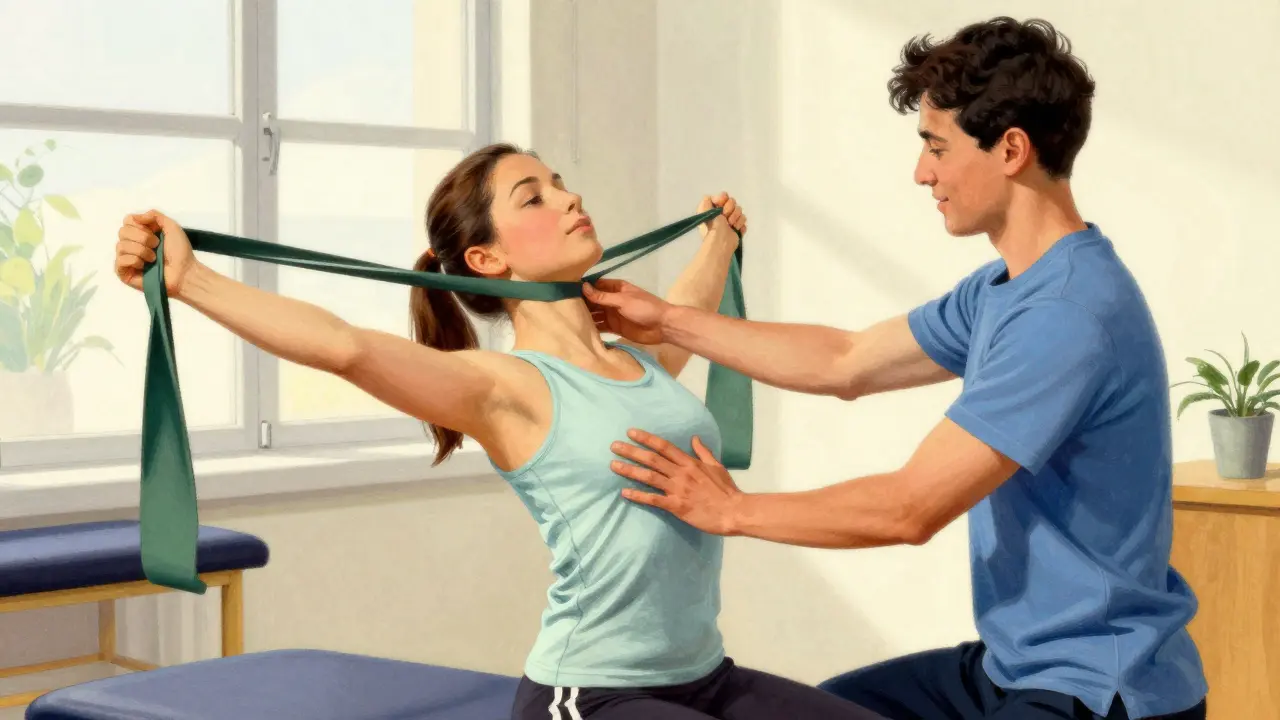
Now you build resilience. Introduce progressive resistance training. Use light resistance bands (TheraBand®) at about 30-40% of your maximum effort. Do two sets of 15 repetitions, three times a week. Focus on strengthening the lower trapezius and serratus anterior muscles. Weakness in these specific muscles is a major contributor to recurrent neck strain. Strengthening them stabilizes your neck and prevents future injuries.
Why Physical Therapy Outperforms Passive Treatments
You might be tempted to seek quick fixes like chiropractic adjustments or massage. While these can provide temporary relief, they do not address the root cause. Data from patient reviews shows that while chiropractic care receives good ratings for immediate relief, 32% of users note the benefits are temporary, requiring ongoing visits. In contrast, physical therapy focuses on restoring function.
Patients who begin physical therapy within 72 hours of injury recover 28% faster than those who wait. The secret weapon in PT is sensorimotor training. This combines manual therapy with exercises that retrain your brain’s awareness of neck position. Recent research indicates that combining manual therapy with sensorimotor training cuts recurrence rates to 18% at 12 months, compared to 39% with manual therapy alone. You are not just healing the tear; you are fixing the movement patterns that caused it.

Preventing Recurrence: Ergonomics and Posture
If you treat the strain but ignore your daily habits, it will come back. Office workers are 2.3 times more likely to suffer from cervical strain than manual laborers, primarily due to prolonged static postures. The culprit is often "forward head posture." For every inch your head moves forward past your shoulders, the effective weight on your neck doubles. An average head weighs 10-12 pounds; push it forward 4 inches, and your neck supports over 40 pounds.
To prevent this:
- Adjust your monitor: The top of your screen should be at eye level so you are not looking down.
- Use a headset: Avoid cradling the phone between your ear and shoulder.
- Take micro-breaks: Every 30 minutes, stand up and perform five chin tucks.
- Sleep smart: Use a pillow that keeps your neck neutral, not bent upward or downward. Memory foam pillows often provide better support than traditional down pillows for side sleepers.
New technology is also helping. Wearable biofeedback devices, like the FDA-approved NeckSense™, use sensors to vibrate when your posture drifts, helping you build awareness. While not necessary for everyone, they can be useful if you struggle to remember to sit up straight.
When to See a Doctor Immediately
Most cervical strains heal on their own with conservative care. However, you should seek professional medical attention if:
- Pain persists beyond 4 weeks despite home treatment.
- You experience numbness, tingling, or weakness in your arms or hands.
- The pain resulted from a high-impact injury, such as a car accident or fall.
- You have fever, headache, or sensitivity to light alongside neck stiffness (signs of meningitis).
- You lose control of your bladder or bowels.
Early intervention is critical. Delayed diagnosis leads to chronicity in 22% of cases. If your acute strain turns into myofascial pain syndrome, treatment becomes significantly longer and more complex. Don’t wait until the pain becomes your new normal.
How long does it take for a cervical strain to heal?
Mild cervical strains typically resolve within 48 to 72 hours. Moderate strains may take 1 to 2 weeks. Severe strains involving significant tearing can require 6 to 12 weeks for full recovery. Starting gentle movement within 72 hours speeds up this process significantly.
Is heat or ice better for neck strain?
Ice is better during the first 72 hours to reduce inflammation and pain. Apply ice for 15-20 minutes every 2-3 hours. After the acute phase passes, you can switch to heat to relax tight muscles and improve blood flow before exercising.
Can cervical strain cause headaches?
Yes. Tension in the neck muscles, particularly the suboccipital muscles at the base of the skull, can refer pain to the head, causing tension-type headaches. Correcting forward head posture and strengthening neck stabilizers often eliminates these headaches.
Should I see a chiropractor or a physical therapist?
For long-term recovery, physical therapy is generally more effective. While chiropractors can provide immediate relief through adjustments, physical therapists focus on active rehabilitation, strengthening, and correcting posture, which reduces the risk of recurrence. Studies show combined manual therapy and sensorimotor training has lower recurrence rates.
What exercises are best for cervical strain?
Start with gentle range-of-motion exercises like chin tucks and scapular retractions. As pain decreases, add resistance band exercises targeting the lower trapezius and serratus anterior. Avoid heavy weights initially. Consistency is key; performing exercises 3 times daily yields the best results.
Does sleeping position affect neck strain recovery?
Yes. Sleeping with your neck twisted or unsupported can aggravate a strain. Aim for a neutral spine alignment. Side sleepers should use a pillow that fills the space between their ear and shoulder. Stomach sleeping is generally discouraged as it forces the neck into extreme rotation.
When should I worry about my neck pain?
Seek immediate medical attention if your neck pain is accompanied by arm weakness, numbness, loss of bladder/bowel control, fever, or if it resulted from a traumatic injury like a car crash. These could indicate serious neurological or structural issues beyond a simple strain.