
When you're on warfarin, your blood takes longer to clot. That’s the whole point. But what you eat can make that job harder-or easier. The key? Vitamin K. It’s not your enemy. It’s not your friend. It’s your balancing act. If your vitamin K intake jumps around, your INR will too. And that’s dangerous.
How Warfarin and Vitamin K Work Together
Warfarin doesn’t thin your blood. It blocks vitamin K from doing its job. Vitamin K is what your liver uses to build clotting factors-proteins that stop you from bleeding out after a cut. Warfarin shuts down the recycling system for vitamin K. Without it, those clotting factors don’t get made. Your blood clots slower. That’s good if you’re at risk for a stroke or clot. But too slow? That’s a bleed waiting to happen.
Here’s the catch: vitamin K from food fights back. Every time you eat spinach, kale, or broccoli, you’re giving your body more of the exact thing warfarin is trying to block. If you suddenly eat a big bowl of kale one day and nothing the next, your INR will swing like a pendulum. One day you’re safe. The next, you’re at risk.
What Foods Have the Most Vitamin K?
Not all vitamin K is the same. The kind that matters most for warfarin is phylloquinone-vitamin K1. It’s mostly in plants. Here’s what’s high:
- 1 cup cooked spinach: 889 mcg
- 1 cup cooked kale: 547 mcg
- 1 cup cooked broccoli: 220 mcg
- 1 cup cooked Brussels sprouts: 219 mcg
- 1 cup raw lettuce (iceberg): 17 mcg
- 1 cup cooked cabbage: 107 mcg
- 1 tablespoon soybean oil: 25 mcg
That’s not a guess. These numbers come from the USDA FoodData Central database, updated in 2023. Foods with more than 60 mcg per serving are flagged by the American Heart Association as high-risk for INR swings. Anything under 35 mcg? Safer to eat regularly. But even safe foods can throw things off if you go from eating them daily to never eating them.
Why Consistency Beats Restriction
Years ago, doctors told patients on warfarin to avoid vitamin K entirely. No greens. No broccoli. Just plain rice and chicken. That didn’t work. People got bored. They cheated. Then their INR crashed. Or they ate a salad once a month and spiked their INR into the danger zone.
Today’s guidelines say the opposite. The 2023 American College of Chest Physicians update says: Don’t cut out vitamin K. Keep it steady. Aim for the same amount every day-within 10-15% variation. That means if you normally eat 1 cup of cooked broccoli (220 mcg), keep eating that. Don’t swap it for 2 cups of iceberg lettuce (34 mcg) just because it’s "lighter."
Why? Because your body adapts. If you eat the same amount daily, your liver learns how much warfarin it needs to balance it out. Your INR stays predictable. You don’t need extra blood tests. You don’t need emergency dose changes.

What Happens When You Change Your Diet?
Real stories tell the truth.
One patient on Reddit went from eating 1 cup of spinach daily to eating 1 cup of kale (547 mcg) because it was on sale. Her INR dropped from 2.8 to 1.9 in three days. She didn’t know kale had more vitamin K than spinach. Her doctor had to increase her warfarin dose by 18%. She almost had a clot.
Another man switched from eating kale every day to eating only iceberg lettuce for two weeks. His INR jumped from 2.3 to 4.1. He started bruising easily. He went to the ER. His warfarin dose had to be cut by 25%.
A 2022 survey by the Blood Clot Organization found that 89% of people who kept their vitamin K intake within 10% of their normal level had time in therapeutic range (TTR) above 70%. Those with inconsistent intake? Only 34% stayed in range. That’s not a coincidence. That’s biology.
How to Keep Vitamin K Stable
You don’t need to become a nutritionist. But you do need a system.
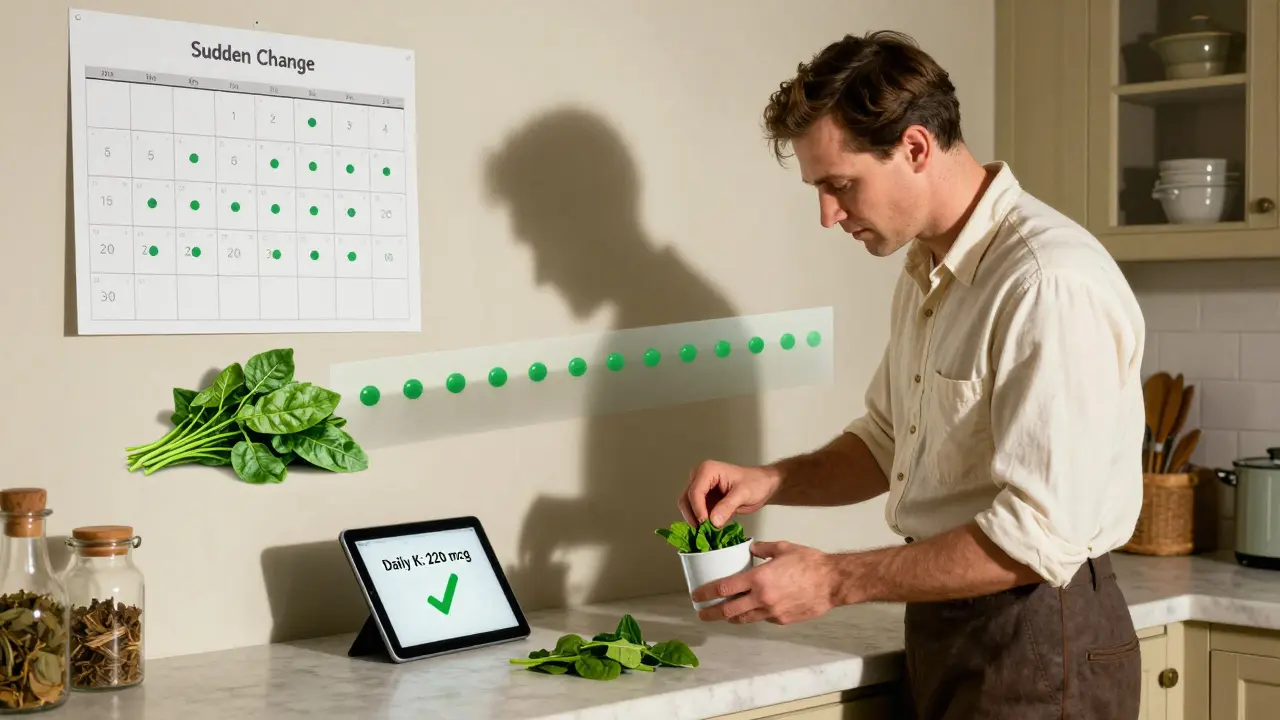
- Pick your serving. Choose one high-vitamin K food you like and eat it every day. Broccoli? Spinach? Kale? Pick one. Stick with it. Measure it. Use a measuring cup. Don’t guess.
- Track it. Use an app like CoumaDiet (rated 4.6/5 on the App Store). Log your meals. It shows you how much vitamin K you’re getting. You’ll be surprised.
- Don’t skip meals. If you normally eat spinach with dinner, don’t skip it because you’re "too busy." Skip it for a week? Your INR will rise.
- Know cooking changes things. Boiling spinach cuts vitamin K by 40%. Steaming? Only 10%. Raw? Full dose. If you switch from steamed to boiled, you’re changing your intake.
- Be careful at restaurants. A salad at a fancy place might have 3 different greens, olive oil, and nuts. That’s 300+ mcg in one bowl. Ask what’s in it. Or stick to grilled chicken and rice.
What About Supplements?
Some people take vitamin K supplements. That’s risky unless your doctor says so. But here’s a twist: research shows that daily low-dose vitamin K (100-200 mcg) can actually help stabilize INR in people with erratic diets. A 2018 study found 83% of patients returned to target INR within 7 days after starting this routine. It’s not a cure. It’s a tool. And it only works if you take it every single day.
Don’t start supplements on your own. Talk to your anticoagulation clinic first.
When to Call Your Doctor
You don’t need to panic over one bad meal. But if you notice any of these, call:
- You ate a huge amount of greens (2+ cups) and didn’t eat any for 3 days before
- You’ve been sick and haven’t eaten normally for 2+ days
- You’re traveling and eating unfamiliar foods
- You’re bruising more than usual or have nosebleeds that won’t stop
- Your INR test came back out of range (below 2.0 or above 3.0)
Don’t wait. INR changes can happen fast. A single meal can shift your clotting risk in 24 hours.
What About Other Anticoagulants?
Not all blood thinners work like warfarin. DOACs-like apixaban (Eliquis), rivaroxaban (Xarelto), or dabigatran (Pradaxa)-don’t interact with vitamin K. If you’re on one of these, you can eat kale, spinach, and broccoli without worry. But if you’re on warfarin? You’re stuck with the rules. And that’s okay. Warfarin is still the only option for people with mechanical heart valves. For them, vitamin K management isn’t optional. It’s life-saving.
Even though DOACs are used in 68% of new prescriptions, nearly 3.5 million Americans still rely on warfarin. That’s a lot of people who need to eat the same way every day.
The Bottom Line
You don’t have to give up your greens. You just have to be consistent. Pick one high-vitamin K food. Eat the same amount every day. Measure it. Log it. Don’t change it unless your doctor tells you to. That’s it.
INR control isn’t about being perfect. It’s about being predictable. Your body doesn’t care if you eat kale or spinach. It cares if you eat the same amount every single day. Do that, and your blood will stay where it needs to be.
Can I eat leafy greens while on warfarin?
Yes-but only if you eat the same amount every day. Eating spinach, kale, or broccoli consistently helps stabilize your INR. Sudden changes in intake cause dangerous swings. Stick to one serving size daily, and avoid switching between high and low vitamin K foods.
What happens if I eat too much vitamin K?
Eating a large amount of vitamin K (like a big bowl of kale) can make warfarin less effective. Your INR will drop, meaning your blood clots faster. This raises your risk for stroke or clotting. If this happens, your doctor may need to increase your warfarin dose. Avoid large, occasional servings.
Should I avoid vitamin K completely?
No. Avoiding vitamin K entirely is outdated and dangerous. It leads to poor nutrition, inconsistent intake, and unpredictable INR levels. Current guidelines recommend consistent intake-not restriction. Aim for 90-120 mcg daily, but keep it steady.
Do cooking methods affect vitamin K in food?
Yes. Boiling vegetables like spinach or broccoli can reduce vitamin K by 30-50%. Steaming, sautéing, or eating raw keeps most of the vitamin K intact. If you change how you cook your food, you’re changing your intake. Stick to one method for consistency.
Can I take a vitamin K supplement?
Only under medical supervision. Some patients with erratic diets benefit from daily low-dose vitamin K (100-200 mcg), which can stabilize INR. But self-prescribing supplements can cause dangerous drops in INR. Always talk to your anticoagulation clinic before starting any supplement.
How often should I get my INR checked?
Monthly testing is standard for most patients on warfarin. If your diet is stable and your INR has been consistent for 3+ months, your doctor may extend it to every 6-8 weeks. But if you change your eating habits, travel, or get sick, expect more frequent checks.





Maranda Najar
February 21 2026Let me tell you something about vitamin K and warfarin-this isn’t just medical advice, it’s a daily tightrope walk over a canyon of clots and bleeds. I’ve seen friends go from perfectly stable INRs to emergency rooms because they thought "a little more kale" wouldn’t hurt. It does. It hurts like hell. Your liver isn’t a suggestion box-it’s a precision instrument calibrated by consistency, not whimsy. One day you’re eating steamed broccoli like a saint, the next you’re scarfing down a raw kale smoothie like it’s a detox trend, and suddenly your INR plummets like a dropped phone. No, you don’t need to give up greens. You need to treat them like your morning coffee: same amount, same time, same ritual. No exceptions. No "I’ll make up for it tomorrow." Tomorrow doesn’t care. Your blood does.